


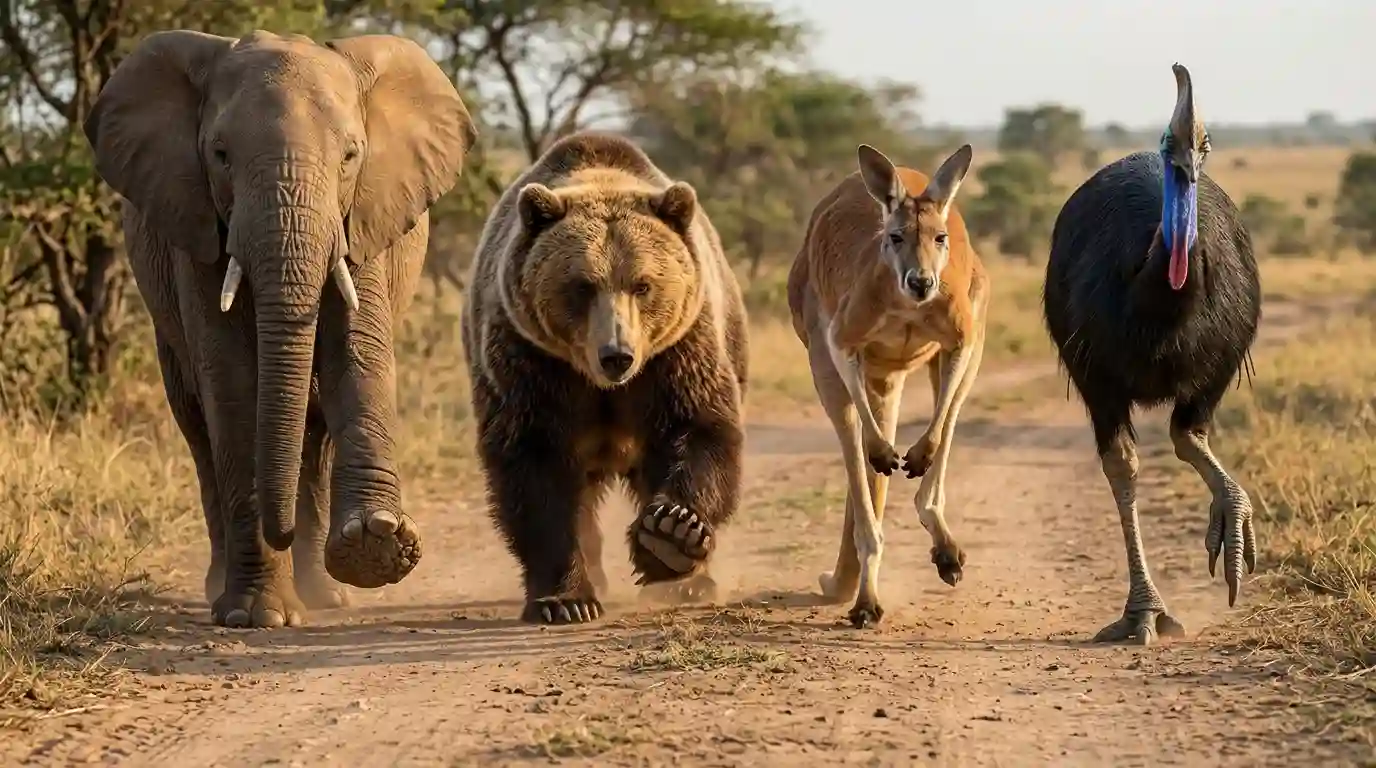
Animals With Big Feet
Some animals have feet that look far too big. An elephant’s foot can be about 19 inches long. A tiny jerboa has hind feet that seem huge for its body.
Big feet are not just for show. They help animals run, hop, swim, balance and stay on top of snow or mud. This guide covers more than 20 animals with big feet, from Africa to the Arctic. You will learn their names, their foot sizes and the reason behind each foot design. You will also find answers about kangaroo feet, webbed feet and tall animals.

Which Animal Has Big Feet? A Quick Answer
Many animals do. Elephants, ostriches, polar bears, kangaroos, giraffes and hippos all have large feet. The African elephant has some of the biggest feet on land. The ostrich has the biggest feet of any bird. The African jacana has the biggest feet for its size.
Why Do Some Animals Have Big Feet?
Foot size usually solves a problem. Here are the five main reasons:
- Weight support: a wide foot spreads weight over more ground. Heavy animals do not sink into mud, sand or snow.
- Speed and power: long feet and strong tendons store energy. This helps ostriches run and kangaroos hop.
- Snowshoe effect: broad, furry feet keep hares, lynx and polar bears on top of snow.
- Walking on water: long toes or skin flaps let some birds and lizards cross water or floating plants.
- Grip and defense: hooves and claws give traction. They also work as weapons.
Animals With Big Feet: Names and Quick Facts
This table lists the best-known animals with big feet in the world. The sections below add more names and details.
| Animal | Foot feature | Reported size or fact | Where it lives |
|---|---|---|---|
| African elephant | Five toes, fatty cushion pad | Foot 15–19 inches long | Africa |
| Ostrich | Two toes | Runs about 45 mph | African savannas |
| Emu | Three toes, sharp talons | Foot up to 12 inches | Australia |
| African jacana | Very long toes | Body only 9–12 inches long | Sub-Saharan Africa |
| Kangaroo | Long hind feet | Over 23 feet per hop | Australia |
| Polar bear | Wide paws | Up to 12 inches across | Arctic |
| Giraffe | Broad hooves | Hoof about 11 inches across | African savannas |
| Lion | Round paws | Up to 6 inches long | Sub-Saharan Africa |
| Snowshoe hare | Furry hind feet | Hops about 27 mph | North America |
| Jerboa | Very long hind feet | Leaps up to 10 feet | North Africa and Asia |
What Animal Has the Biggest Feet?
The answer depends on how you measure. In plain size, the African elephant has some of the biggest feet on land. Among birds, the ostrich wins. Compared with body size, the African jacana is the best example.
What Animal Has the Biggest Feet to Body Ratio?
No study ranks every species by foot-to-body ratio. So the table below groups animals by how big their feet look for their size. It does not invent exact numbers.
| Animal | Absolute foot size | Foot size for its body | Why it matters |
|---|---|---|---|
| African jacana | Small | Extreme | Discover Wildlife says jacanas have the biggest toes for their body size |
| Jerboa | Tiny | Very high | Long hind feet power big leaps |
| Snowshoe hare | Small | High | Large hind feet keep it on top of snow |
| Kangaroo | Large | High | The family name means “big feet” (San Diego Zoo) |
| Ostrich | Largest of any bird | Moderate | Two toes built for speed |
| African elephant | Very large | Proportionate | Feet carry several tons |
| Giraffe | Large | Proportionate | Broad hooves support great height |
In short, big animals have the biggest feet overall. Small specialists have the biggest feet for their body.
How Do These Feet Compare With Yours?
An adult human foot is about 10 inches long, though sizes vary. Here is how some animal feet stack up.
| Animal | Foot or paw size | Compared with a human foot |
|---|---|---|
| African elephant | 15–19 inches long | Up to nearly twice as long |
| Giraffe | About 12 inches long | A little longer |
| Emu | Up to 12 inches long | A little longer |
| Polar bear | Up to 12 inches across | Much wider |
| Lion | Up to 6 inches long | About half as long |
Large Land Animals With Big Feet
African Elephant and Asian Elephant
The elephant is the largest land animal. Its feet must carry several tons. Each round foot has five toes, but not every toe has a nail. A fatty cushion pad under the foot absorbs shock and spreads weight. That pad also helps elephants walk quietly. The Asian elephant is smaller than the African elephant, so its feet are smaller too.

White Rhinoceros
The white rhinoceros (Ceratotherium simum) has three toes on each foot. Thick pads support a body of about two tons. The wide stance keeps it steady when it runs across uneven ground.

Hippopotamus
The hippopotamus (Hippopotamus amphibius) has four toes on each foot. Partial webbing joins them. A big male can weigh around 4,000 pounds. The wide feet help it stand on muddy banks and push off river bottoms.
Giraffe
The giraffe (Giraffa camelopardalis) is the tallest animal. Its legs are about 6 feet long. Each broad hoof is about 11 inches across, which is roughly the size of a dinner plate. The hooves support its height and let it sprint at about 35 mph. A kick from a giraffe can also stop a lion.
Camel
A camel has two toes on each foot. A wide, leathery pad joins them. The pad spreads weight over loose sand, so the camel does not sink in the desert.

Moose
The moose (Alces alces) stands up to about 6.5 feet tall at the shoulder. Its large hooves spread wide. This helps it cross snow, soft ground and shallow water. Moose are also strong swimmers.
Gorilla
The gorilla (Gorilla gorilla) has broad feet with a grasping big toe. The feet support its heavy body on the ground. They also help it climb.
Predators With Big Paws
Polar Bear
The polar bear (Ursus maritimus) is the largest land carnivore. Its paws are the biggest of any bear, up to about 12 inches (30 cm) across. They work like snowshoes on ice and like paddles in the water. Each paw has five toes with claws that cannot pull back. The claws grip ice and catch prey.
Lion
The lion (Panthera leo) has round paws up to about 6 inches long. Soft pads help it sneak up on prey. Its claws can reach 1.5 inches and stay sharp until the lion needs them.
Birds With Big Feet

Ostrich
The ostrich (Struthio camelus) is the largest living bird. It can grow up to about 9 feet tall. It walks and runs on two feet, and each foot has only two toes. The larger toe has a claw that looks like a hoof. Springy tendons and long feet help the ostrich run about 45 mph. It can also kick hard enough to hurt a predator.
Emu
The emu is another flightless bird. It has three toes on each foot, and each toe ends in a sharp talon. The foot can be up to 12 inches long. Emus run about 31 mph and can cover around 7 feet in one step.
African Jacana
The African jacana (Actophilornis africanus) is known as the “Jesus bird” and the “lily trotter.” It looks like it walks on water. In truth, its long toes and claws spread its weight across lily pads. The bird is only about 9 to 12 inches (23 to 31 cm) long. Even so, its toes are so long that Discover Wildlife names jacanas the birds with the biggest toes for their size.
American Coot
The American coot is a black waterfowl with a white bill. Its toes are not webbed. Instead, each toe has lobes of skin. These lobes help it swim and walk on mud, grass and snow.
Kangaroo Feet: Built for Hopping
Kangaroos belong to the family Macropodidae. The San Diego Zoo says the name means “big feet.” It fits well. In most kangaroos, the hind legs and feet are much larger and stronger than the front limbs.
The family is bigger than most people think. Wallabies, wallaroos, quokkas and pademelons are macropods too, so they share the same big-footed design. The kangaroo is also the tallest marsupial, standing over 6 feet tall, says National Geographic Kids.
How Kangaroo Feet Work
A kangaroo hops with both feet pushing off at the same time. Scientists call this saltation. Strong leg muscles and tendons store energy like springs. A kangaroo actually burns less energy the faster it hops, up to a cruising speed of about 20 mph.
How Far and Fast Can They Go?
The San Diego Zoo reports that large kangaroos cover more than 23 feet (7 meters) per hop at cruising speed. They can top 30 mph in short bursts. In an emergency, a red kangaroo can leap about 10 feet high and 39 feet long. A typical big bound is closer to 30 feet, according to National Geographic Kids.
Small Animals With Big Feet
Some of the most surprising animals with really big feet are small. Their feet look large because their bodies are tiny.
- Jerboa: this desert rodent is only about 6 inches tall. It has very long hind feet and leaps up to 10 feet. That is about 20 times its height. Its tufted tail helps it balance.
- Snowshoe hare: large, furry hind feet stop it from sinking in snow. It hops at about 27 mph to escape lynx and great horned owls. Its fur turns white in winter and brown in summer.
- Water-walking basilisk: this lizard lives in tropical forests from Mexico to South America. It runs across water on its long back toes. Skin ridges on the toes widen when they hit the surface. The lizard sinks after a few yards.
- Quokka and pademelon: these small macropods have the same big-footed design, just in miniature.

How Many Toes Do Big-Footed Animals Have?
Toe count says a lot about how an animal moves. Fewer toes usually mean more speed. More toes usually mean more grip.
| Animal | Toes per foot | Note |
|---|---|---|
| Ostrich | 2 | The only bird with two toes |
| Giraffe | 2 | Two-toed hoof |
| Camel | 2 | Joined by a wide pad |
| Rhinoceros | 3 | Thick pads under each foot |
| Emu | 3 | Sharp talons |
| Hippopotamus | 4 | Partly webbed |
| American coot | 4 | Three face forward, one faces back |
| Lion | 5 front, 4 back | Claws pull back |
| Polar bear | 5 | Claws do not pull back |
| African elephant | 5 | Not every toe has a nail |
| Gorilla | 5 | Grasping big toe |
Types of Animal Feet and Their Names
You can sort animal feet in two ways: by how the animal walks, and by what the foot does best.
Three Ways Animals Walk
- Plantigrade: the animal walks on the whole sole of its foot. Bears and gorillas do this, and so do humans.
- Digitigrade: the animal walks on its toes. Lions, lynx and ostriches move this way, which helps them stay quiet and fast.
- Unguligrade: the animal walks on hooves at the tips of its toes. Giraffes, moose and rhinos belong here.
Foot Types by Job
This table sorts feet by their main job.
| Foot type | Examples | What it does best |
|---|---|---|
| Webbed | Duck, otter, frog, beaver, penguin | Swimming |
| Lobed toes | American coot | Swimming and walking on mud |
| Padded paw | Polar bear, lion, lynx | Quiet steps, grip, snow travel |
| Cushioned pad | Elephant | Absorbing shock and carrying weight |
| Hoofed | Giraffe, moose, rhinoceros | Carrying heavy bodies and running |
| Hopping foot | Kangaroo, jerboa | Energy-saving leaps |
| Long-toed wading foot | African jacana | Walking on floating plants |
Webbed Feet Animals: Meaning
Webbed feet are feet with skin between the toes. The skin works like a paddle. It pushes more water with each stroke. Ducks, otters, frogs and beavers are webbed feet animals. The hippo has partial webbing. The coot has lobed toes instead.
How Tall Are Animals With Big Feet?
What Animal Is 6 Feet Tall?
Several animals reach about 6 feet. A big male red kangaroo can stand over 6 feet tall, says the San Diego Zoo. An emu stands about 5 to 6 feet tall. A moose is about 6.5 feet tall at the shoulder.
What Animals Are 7 Feet Tall?
The tallest male eastern gray kangaroo reaches 7 feet, per the San Diego Zoo. An ostrich can grow up to about 9 feet, so a 7-foot ostrich is common. A giraffe is much taller. Its legs alone are about 6 feet long.
What Are the Big 7 Animals?
The Big 7 are the Big Five plus two sea giants. The Big Five are the lion, leopard, rhinoceros, elephant and Cape buffalo. Hunters first used that name for the five most dangerous animals to hunt on foot. South Africa later added the great white shark and the southern right whale. That made the Big 7.
You can see all seven in the Eastern Cape, including Addo Elephant National Park, says South African Tourism. Three of the Big Five are big-footed animals from this guide: the elephant, the rhino and the lion.
Frequently Asked Questions
Ostriches, emus and humans walk on two feet. Kangaroos hop on their hind feet.
The polar bear. Its paws can be about 12 inches across.
Yes, but some toes have no nail.
Yes. A giraffe’s hoof is about 11 inches across, roughly the size of a dinner plate.
Ducks, otters, frogs, beavers and penguins do. Hippos have partial webbing.
The African jacana. Its toes are very long for its 9 to 12 inch body.
Final Thoughts
Animals with big feet show how nature fits the body to the habitat. Elephants, rhinos and giraffes need wide feet to carry their weight. Kangaroos and jerboas use long feet to hop. Jacanas, hares and polar bears use wide feet to cross water and snow. Whether you count size or body ratio, there is almost always a clear reason behind big feet.
