


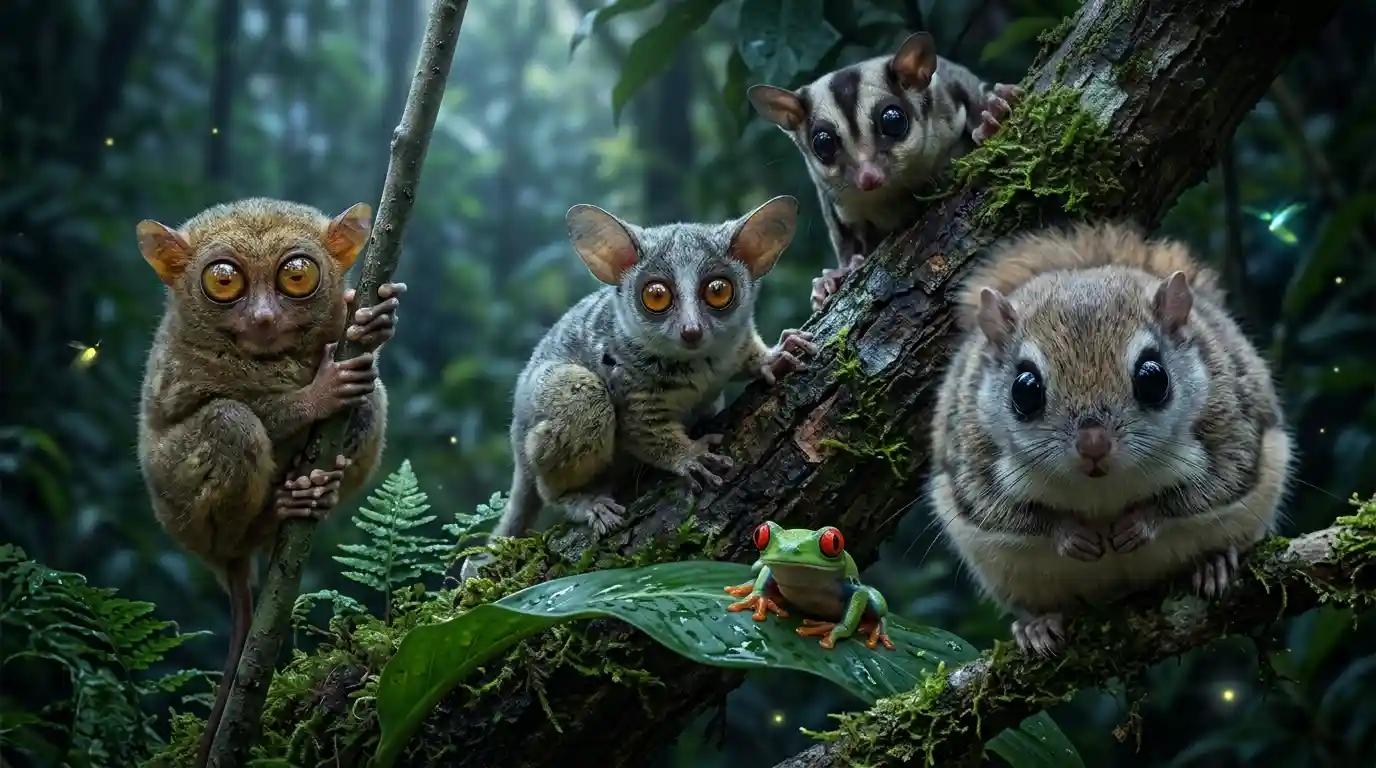
Some animals look like they are all eyes. A tarsier fits in your hand. Each eye is about as big as its brain. Its eyes shine in the dark.This guide covers 18 small animals with big eyes. You will learn their names, where they live and how they use their eyes. Some are good pets. Others must stay wild.Others must stay wild.

| Animal | Type | Where it lives | Rough size |
|---|---|---|---|
| Tarsier | Primate | Southeast Asia | 10–15 cm |
| Galago (bush baby) | Primate | Africa | 15–20 cm, plus a long tail |
| Mouse lemur | Primate | Madagascar | 9–14 cm |
| Slow loris | Primate | South and Southeast Asia | 20–38 cm |
| Sugar glider | Marsupial | Australia, New Guinea | 12–15 cm, plus a long tail |
| Japanese dwarf flying squirrel | Rodent | Japan | 14–20 cm |
| Chinchilla | Rodent | Andes, South America | 25–35 cm |
| Jerboa | Rodent | Africa, Asia | 5–15 cm, with a longer tail |
| Hazel dormouse | Rodent | Europe | 6–9 cm |
| Margay | Wild cat | Central and South America | 50–80 cm |
| Little owl | Bird | Europe, Asia, North Africa | About 22 cm |
| Tree frog | Amphibian | Many warm regions | 3–8 cm |
| Gecko | Reptile | Warm regions worldwide | A few cm to 25 cm |
| Chameleon | Reptile | Africa, Madagascar, parts of Asia and Europe | 2–60 cm |
| Dragonfly | Insect | Almost worldwide | Wingspan: 5–10 cm |
| Zebra jumping spider | Spider | Europe, Asia, North America | 0.5–0.7 cm (5–7 mm) |
| Ogre-faced spider | Spider | Warm regions | Body: about 2–2.5 cm |
| Telescope goldfish | Fish | Bred worldwide | 10–20 cm |

Why Do Some Animals Have Big Eyes?
Most big-eyed animals are active at night. A big eye has a big pupil, and a big pupil lets in more light. That helps an animal see in the dark.
Many night animals have a second trick. A shiny layer behind the retina, called the tapetum lucidum, bounces light back through the eye. This is why a cat’s eyes glow in a flashlight beam. Galagos have this layer. Tarsiers do not. They rely on eye size alone.
Big eyes have a cost. They are heavy and take up space in a small skull. Many of these animals cannot move their eyes. They turn their heads. Tarsiers and owls do this.
Big eyes do not always mean sharp sight. Most are built for dim light, not for fine detail in the sun. Chameleons and dragonflies use big eyes for a different job. They need a wide view to spot prey and danger.
Eye Size Compared With Body Size
Eye size alone can mislead. A colossal squid’s eye is bigger a tarsier’s head. For small animals, it is better to compare eye size with body size. A tarsier’s eyes fill much of its face. Human eyes fill a small part of ours. Small night hunters often have the biggest ratios. They need to catch every bit of light.
Small Monkey-Like Animals With Big Eyes
These animals look like tiny monkeys.But they are not true monkeys. Tarsiers, galagos, lorises and lemurs belong to their own primate groups. All are active at night.


1. Tarsier
Tarsiers live on islands in Southeast Asia. They are about 10 to 15 cm long and eat insects and other small animals. Among mammals, they have the biggest eyes for their body size.
Each eyeball is about 16 mm wide, roughly as big as the tarsier’s brain. The eyes cannot move. The tarsier turns its head up to 180 degrees. It leaps long distances between trees.
2. Galago (Bush Baby)
Galagos live in the forests and savannas of Africa. People call them bush babies some of their calls sound like a crying baby. They have round eyes, big ears and a long tail.
They are fast jumpers that leap from branch to branch. At night, their eyes and ears work together to find food.
3. Mouse Lemur
Mouse lemurs live only on Madagascar. They are among the smallest primates in the world. The smallest species weighs about 30 grams.
Their big dark eyes help them move through the forest at night. They eat fruit, flowers and insects. Trying to recall the name of a lemur with big eyes? A mouse lemur is a good guess.The aye-aye is a larger primate from Madagascar. It has big eyes it looks different.
4. Slow Loris
Slow lorises live in the forests of South and Southeast Asia. Their big, round eyes give them a soft, sweet look. They move slowly through the trees at night and eat insects, fruit and tree gum.
Do not be fooled by the cute face. A slow loris makes a toxin in a gland near its elbow. It mixes the toxin with saliva.its bite can be harmful. Most species are threatened, and the illegal pet trade is one of the biggest dangers.
Tarsier vs Galago: How to Tell Them Apart
People often mix up these two. The clues are simple.
- Home: tarsiers live in Southeast Asia. Galagos live in Africa.
- Night vision: galagos have a tapetum lucidum. Tarsiers do not.
- Ears: galagos have big ears that they can fold.
Cute Furry Animals With Big Eyes
These furry animals are the ones people most want to cuddle. Some can live as pets. Others belong in the wild.


5. Sugar Glider
Sugar gliders are small marsupials from Australia and New Guinea. They are 12 to 15 cm long. A fold of skin between the arms and legs lets them glide. It is called a patagium. One glide can cover up to 50 metres.
Their large dark eyes help them see at night.
They feed on sap, nectar, and insects. They live in groups and need other gliders for company.
6. Japanese Dwarf Flying Squirrel
This tiny squirrel lives in the forests of Japan. It has big black eyes and a fluffy tail. A fold of skin along its body lets it glide from tree to tree at night.
It eats buds, leaves, seeds and tree sap.It carries seeds, it helps new trees grow. In Japan, it is very popular and often appears in toys and art.
7. Chinchilla
Chinchillas come from the Andes mountains in South America. They have thick, soft fur and large dark eyes. Their bodies are about 25 to 35 cm long.
They are most active at dusk and at night. In the wild, they are endangered. Pet chinchillas can live ten years or more.They need a cool room and regular dust baths. Looking for a chinchilla-like animal with big eyes? The jerboa the dormouse both fit. They live in different places.
8. Jerboa
Jerboas are desert rodents from Africa and Asia. They have big eyes, big ears and long back legs. They hop like tiny kangaroos. Their tails are longer their bodies and often end in a tuft.
They hide in burrows by day and come out at night. Big eyes help them spot seeds and insects in the dim desert light. Big ears help them hear danger.
9. Hazel Dormouse
The hazel dormouse lives in woodlands and hedgerows across Europe.It has golden-brown fur and big black eyes. It is 6 to 9 cm long.
It hibernates for several months each winter. In the warm season, it eats flowers, fruit, nuts and insects. In the UK, it is a protected species.
10. Margay
The margay is a small wild cat from Central and South America. It is about the size of a large house cat. Its eyes are very large for a cat, and they help it hunt at night in the rainforest.
Margays spend most of their lives in trees. They can turn their back ankles almost 180 degrees. That lets them climb down a trunk head first. Margays are not pets. Loss of forest is their main threat.
Birds, Frogs and Reptiles With Big Eyes
11. Little Owl
The little owl is about 22 cm long. It lives in Europe, Asia and North Africa. Its large yellow eyes sit in a flat, serious-looking face.
Like other owls, it cannot move its eyes much. It turns its head . The little owl hunts insects, worms and small mammals, often at dusk. It nests in old buildings, stone walls and tree holes.
12. Tree Frog
Tree frogs are small amphibians with big eyes. Many species hunt at night. The red-eyed tree frog is one of the best known. It sleeps by day with its eyes closed its legs tucked in its green body blends into the leaves.
Frog eyes sit high on the head a frog can see around. most of its body stays hidden. Frogs use their eyes to swallow. The eyeballs sink into the head and push food down the throat.
13. Gecko
Geckos are small lizards found in warm places around the world. Many are nocturnal and have large eyes with narrow, vertical pupils. Many geckos have no movable eyelids. They lick their eyes to keep them clean.
Some geckos can see color even in very dim light. Humans cannot do that. Leopard geckos are an exception to the eyelid rule. They have real eyelids and blink.
14. Chameleon
Chameleons are best known for color change their eyes are just as odd. Each eye can move on its own. One eye can look forward the other looks back. Together, they give a view of almost all the way around.
A chameleon spots prey, both eyes turn to the front. That gives it the depth it needs to shoot out its tongue. Chameleons range from tiny species under 3 cm long to giants over 60 cm.
Insects, Spiders and Fish With Big Eyes


15. Dragonfly
A dragonfly’s eyes cover most of its head. Each eye is made of thousands of tiny lenses, as many as about 30,000 in some species. This gives the dragonfly a view of almost 360 degrees.
Dragonflies see color well and spot tiny insects in flight. They often catch prey in mid-air. Adult dragonflies near a pond can be a sign of a healthy wetland their young live in clean water.
16. Zebra Jumping Spider
The zebra jumping spider is only 5 to 7 mm long. You can find it on walls, fences and rocks. Two big eyes at the front give it sharp vision.
It does not spin a web to catch food. It stalks its prey and jumps. Its big eyes help it judge the distance it leaps. The black and white stripes explain its name.
17. Ogre-Faced Spider
This spider has two huge eyes on its face, like dark headlights. They are among the largest eyes of any spider and work well in dim light.
It hunts at night. It holds a small net between its front legs and waits.An insect walks past, it throws the net over it. By day, it hangs from a branch and looks like a twig.
18. Telescope Goldfish
The telescope goldfish was bred in China. Breeders chose fish with bulging eyes. Over many generations, the eyes grew larger and rounder. This is not a wild animal, it shows how people can shape eye size through breeding.
Its eyes stick out from the sides of the head, they are easy to injure on sharp tank decorations. Its sight is weaker that of other goldfish. A smooth, clean tank keeps it safe.
What They Eat and How Their Eyes Help Them Hunt
Big eyes are tools for finding food. Tarsiers, geckos and little owls spot insects and small prey in dim light. Galagos and mouse lemurs find fruit and insects in dark forests. Chameleons and zebra jumping spiders judge distance they strike. Dragonflies track prey in flight. Margays hunt rodents and birds in the treetops. Dormice and flying squirrels use big eyes to find plant food and move safely at night.
How to Identify an Animal You Saw
These clues can help.
- Hopping like a tiny kangaroo in a desert: jerboa
- Gliding between trees at night: sugar glider (Australia, New Guinea) or Japanese dwarf flying squirrel (Japan)
- Tiny, golden and furry in a European hedge: hazel dormouse
- Jumping on a sunny wall: zebra jumping spider
- Bright red eyes on a green frog: red-eyed tree frog
Location helps too. Africa has galagos. Madagascar has mouse lemurs. Southeast Asia has tarsiers and slow lorises. Australia and New Guinea have sugar gliders. South America has chinchillas. Central and South America have margays and ogre-faced spiders. Europe has hazel dormice and little owls.
How They Compare With the Animals That Have the Biggest Eyes
None of the animals above hold the world records. Those belong to much larger animals.
- The colossal squid has the largest eyes in the animal kingdom, up to about 28 cm across.
- The ostrich has the largest eyes of any land animal.
- The vampire squid has the largest eyes for its body size of any animal. Each eye is only about 2.5 cm wide.
- Among mammals, the tarsier wins for eye size compared with body size.


Can You Keep Them as Pets?
Cute does not mean easy. Some big-eyed animals suffer in homes. Others do well with the right care. Laws differ by country and by state check local rules first.
| Animal | Good Pet? | Why |
|---|---|---|
| Tarsier | No | It struggles in captivity and may be protected by law. |
| Slow loris | No | The wildlife trade is restricted, and its bite can be venomous. |
| Galago (bush baby) | Not recommended | It is a wild primate that needs plenty of space and an active night-time routine. |
| Sugar glider | Sometimes | It may be illegal in some places. It needs company, a tall cage, and a balanced diet. |
| Japanese dwarf flying squirrel | Rarely | It is shy and delicate, so it needs expert care. |
| Chinchilla | Yes, with care | It needs a cool room, regular dust baths, and long-term care. |
| Hazel dormouse | No | It is a protected wild species in some regions. |
| Leopard gecko | Yes | It is often suitable for beginners who can provide the right care. |
| Chameleon | For experienced keepers | It needs the right temperature, humidity, and space. |
| Telescope goldfish | Yes, with care | It needs a spacious tank with smooth surfaces and good water quality. |
| Margay | No | It is a wild cat with special needs and should not be kept as a pet. |
You choose a pet, ask four questions. Is it legal where you live? How long will it live? Can you give it the right food, heat and space? Can a vet near you treat it?
Why Wild Big-Eyed Animals Need Our Help
Many of these animals face the same problems. Forests are shrinking. Poachers take wild animals for the pet trade. Tarsiers and slow lorises are hit hardest.
Light and noise matter too. Artificial light at night can disturb animals whose eyes are made for darkness. Noise from towns can wake tarsiers they sleep by day.
Not every species is at equal risk. Chinchillas, several tarsiers and most slow lorises are threatened in the wild. The margay is listed as near threatened. Sugar gliders, flying squirrels and little owls are in less danger.Check the IUCN Red List for the latest status.
All slow lorises are listed under CITES Appendix I, which bans international commercial trade. You can help in simple ways. Never buy a wild-caught pet. Avoid tourist photo stunts with wild animals. Support groups that protect forests.
Common Myths About Big-Eyed Animals
Myth: Big eyes mean better eyesight. Most big eyes help animals see in dim light. They do not always give sharp daytime vision.
Myth: All animals can move their eyes. Tarsiers and owls cannot. They turn their heads.
Myth: A cute face means a good pet. Slow lorises and tarsiers look sweet they suffer in homes.
Small Stuffed Animals With Big Eyes
Some people search for small stuffed animals with big eyes. There is no single name for them. Many toy makers copy real animals, as owls, lemurs and sugar gliders. Shops often list them as big-eye plush or kawaii plush. Add an animal name to your search for better results.


FAQs About Small Animals With Big Eyes.
The tarsier is the best-known answer. This tiny primate from Southeast Asia has eyes about as big as its brain. Galagos, mouse lemurs and sugar gliders have big eyes for their size.
Sugar gliders, chinchillas, hazel dormice, Japanese dwarf flying squirrels and mouse lemurs are popular picks. Slow lorises look cute too,they are wild animals and should never be kept as pets.
Small ones include tarsiers, galagos, little owls, tree frogs and dragonflies. Large ones include the colossal squid, the ostrich and the horse.
The colossal squid. Its eyes can reach about 28 cm across. The ostrich has the largest eyes of any land animal.
No. Tarsiers form their own group of primates. They are not monkeys and not lemurs.
Their eyes are big that they fill most of the skull. There is little room for eye muscles. The tarsier turns its head.
Chinchillas, leopard geckos and telescope goldfish can do well with proper care. Sugar gliders can be pets where the law allows. Keep them in pairs.Tarsiers, slow lorises, galagos and margays should stay wild
Often, yes. A bigger eye gathers more light. Some animals have a tapetum lucidum. It boosts night vision.
No. Chameleons, dragonflies and jumping spiders are active by day. They use big eyes for a wide view or exact depth, not for night vision.
Some can. Dragonflies see a wide range of colors. Some geckos see color in very dim light. Many night animals see fewer colors,their eyes focus on catching light.
Conclusion
Small animals with big eyes come in many shapes.Some are furry gliders and rodents. Others are birds, frogs, lizards, spiders and even fish.
In most cases, big eyes help animals see at night. They have trade-offs, like fixed eyes. Many of these animals face forest loss and the pet trade. Enjoy them from afar, and leave wild animals in the wild.
It is the best example of how far evolution can push eye size.
