


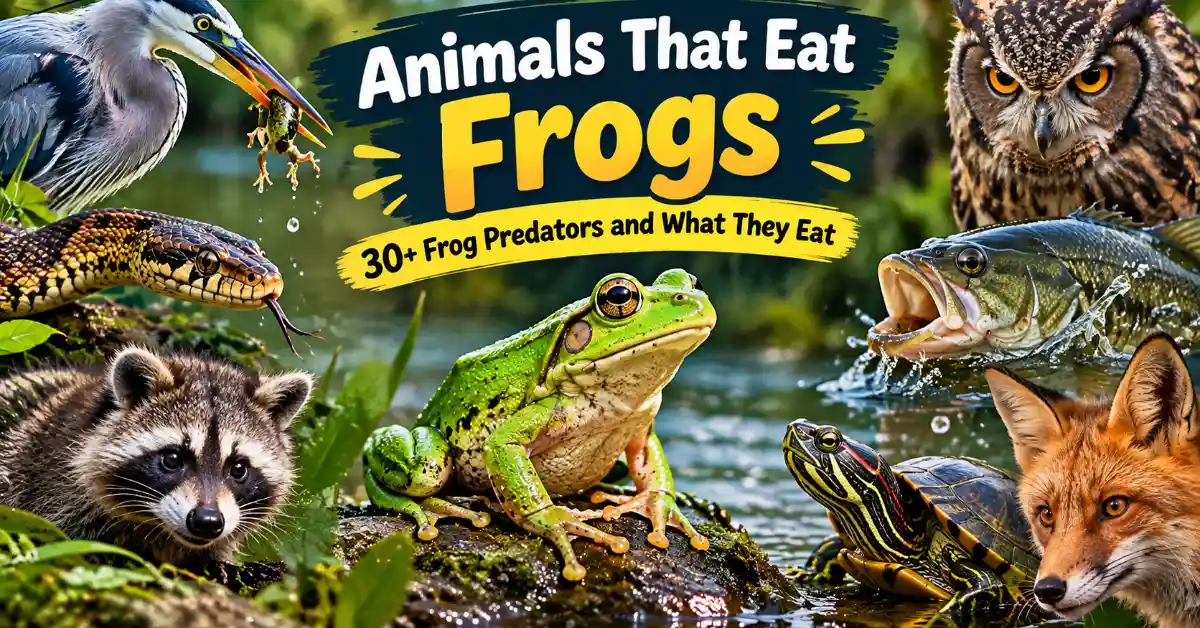
Frogs may be small, but they are an important part of many ecosystems. They eat insects and other small animals, yet they are also food for birds, snakes, fish, mammals, reptiles, amphibians, and even other frogs.
So, what animals eat frogs? The answer depends on the frog’s size, life stage, habitat, and the predators living nearby. A frog in a pond may face fish and water birds, while a tree frog may be hunted by snakes, birds, or climbing lizards.
Frog eggs and tadpoles have their own predators too, including aquatic insects, fish, crayfish, salamanders, and other aquatic animals.
This guide explains the most important animals that eat frogs, where they hunt them, how they catch them, and why frogs are such an important part of the food chain.
What Animals Eat Frogs?
Frogs are prey for a surprisingly wide range of animals.
Some of the main frog predators include:
- Snakes
- Herons
- Egrets
- Storks
- Kingfishers
- Hawks
- Owls
- Crows
- Ducks
- Cranes
- Raccoons
- Otters
- Foxes
- Skunks
- Badgers
- Opossums
- Weasels
- Wild pigs
- Lizards
- Alligators
- Turtles
- Fish
- Eels
- Salamanders
- Newts
- Larger frogs
- Crayfish
- Giant water bugs
- Water beetles
- Dragonfly larvae
- Leeches
- Some snails
- Spiders
Not every predator eats every type of frog. Some mainly eat tadpoles or eggs, while others are capable of catching adult frogs.
Frogs are vulnerable throughout their entire life cycle, from eggs and tadpoles to froglets and adults.

1. Snakes
Snakes are among the most important predators of frogs.
Many snakes live around ponds, streams, wetlands, forests, and other places where frogs are common. Garter snakes and water snakes are well-known examples of snakes that can include frogs in their diet.
A snake may wait near the edge of a pond and strike when a frog comes within reach. Some species actively search through vegetation and wet areas for amphibians.
Snakes have an advantage because they can move quietly and reach frogs in places where larger predators cannot.
Do snakes eat frogs at night?
Yes. Some snakes are active at night and can hunt frogs after dark. A frog’s nighttime activity does not necessarily make it safe from predators.
2. Herons
Herons are classic frog predators.
These long-legged water birds often hunt in shallow ponds, marshes, streams, and wetlands. They can stand almost motionless before making a quick strike with their long bills.
A frog sitting beside the water may be difficult for a human to notice, but a heron can patiently watch the area until the frog moves.
Herons may eat both adult frogs and smaller amphibians when available.
3. Egrets
Egrets are another group of wading birds that can prey on frogs.
Like herons, they often hunt around shallow water. Their long legs allow them to move through wetlands while keeping much of their body above the water.
They can use their sharp bills to grab frogs, tadpoles, fish, and other small aquatic animals.
4. Storks
Storks can also eat frogs.
Their large size and long bills allow them to search shallow water and wet ground for prey. Frogs are particularly vulnerable when they are sitting in exposed areas without enough vegetation or shelter.
5. Kingfishers
Kingfishers are usually associated with fish, but frogs can also become part of their diet.
A kingfisher can sit on a branch and watch the water below. When it spots prey, it can make a rapid movement toward the target.
This makes frogs living near streams and ponds vulnerable to these birds.
6. Hawks
Hawks are primarily predators of other animals, and some species will take frogs when the opportunity is available.
A hawk can spot a frog from above and descend quickly. Frogs crossing open ground are particularly exposed because there may be fewer places to hide.
7. Owls
What eats frogs at night?
Owls are one possible answer.
Many owls hunt after dark, while many frog species become active around the same time. This creates an overlap between predator and prey.
An owl may locate a frog visually or through sound and then swoop down to capture it.
So being nocturnal may help a frog avoid some daytime predators, but it also exposes the animal to nighttime hunters.
8. Crows
Crows are intelligent, adaptable birds with broad diets.
They may eat frogs when they encounter them, particularly around wet areas, vegetation, and shallow water.
Crows can also search through leaves, rocks, and other hiding places where small animals are found.
9. Ducks and Other Water Birds
Ducks and other water birds can feed on frogs and their younger life stages.
Frog eggs and tadpoles are particularly vulnerable in ponds because they remain in the same aquatic environment as many water birds.
A frog does not need to become an adult before entering the food chain.
10. Cranes
Cranes are large wading birds that consume a wide variety of prey.
Depending on the species and habitat, their diet can include frogs and other small aquatic or terrestrial animals.
Their height gives them a good view over shallow water and wet grasslands, where frogs may be hiding.
11. Raccoons
Raccoons are opportunistic feeders.
They search along pond edges, streams, marshes, and other wet areas for food. Their varied diet can include frogs, crayfish, fish, insects, eggs, and many other small animals.
Because raccoons can forage both on land and in shallow water, frogs can encounter them in several different situations.
12. Otters
Otters are highly adapted to aquatic environments.
They commonly hunt in rivers, streams, lakes, and wetlands. While fish may make up an important part of their diet, amphibians such as frogs can also be prey.
A frog entering the water may therefore encounter a predator that is much better adapted to swimming.
13. Foxes
Foxes are opportunistic predators.
They eat a variety of foods rather than depending on one particular prey species. When a fox encounters a frog near water, grass, or vegetation, the frog can become an easy meal.
Young frogs may be especially vulnerable because they are smaller and have fewer escape options.
14. Skunks
Skunks are omnivorous animals that search through soil, vegetation, and other habitats for food.
They may eat frogs along with insects, small animals, eggs, and other available foods.
A frog moving across the ground at night can encounter a skunk while both animals are active.
15. Badgers
Badgers are powerful ground-foraging predators.
They can search through soil, vegetation, and wet areas for small animals. Frogs may become part of their diet when encountered.
Their strong digging ability also allows them to investigate places where frogs and other small animals hide.
16. Opossums
Opossums are highly opportunistic feeders.
They can consume many different foods, including insects, small animals, eggs, and amphibians.
A frog found close to human settlements, gardens, ponds, or forest edges may therefore encounter an opossum.
17. Weasels
Weasels are fast-moving predators that hunt small animals.
Depending on the species and habitat, they can prey on amphibians as well as mammals, birds, and other small animals.
A frog hiding close to the ground may be vulnerable when a weasel searches through vegetation.
18. Wild Pigs
Wild pigs have extremely broad diets.
They can eat roots, insects, eggs, small animals, and other available food. Frogs can become prey when wild pigs encounter them around wet areas.
Their feeding behavior can also disturb frog habitats by turning over soil and vegetation.
19. Lizards
Large lizards can prey on frogs.
Monitor lizards and tegus, for example, are capable of eating a wide range of animals. A small or medium-sized frog may be within the size range of prey they can capture.
Some lizards rely on stealth, while others actively search through vegetation and ground cover.
20. Alligators
Alligators are powerful aquatic predators.
Although frogs are small compared with an adult alligator, they can still become prey when an alligator encounters them near water.
Young frogs and other small animals may be particularly vulnerable.
21. Turtles
Some turtles eat frogs and other amphibians.
Snapping turtles, for example, are capable predators that can ambush animals in ponds and other freshwater habitats.
A frog entering the water may therefore face predators from above, below, and along the shoreline.
22. Fish
Fish are extremely important frog predators in aquatic habitats.
Large predatory fish such as:
- Bass
- Pike
- Trout
- Catfish
- Walleye
can prey on frogs or their younger life stages.
Fish can also eat frog eggs and tadpoles. In some ponds, tadpoles may spend their entire early life surrounded by potential aquatic predators.
23. Eels
Eels are aquatic predators that can consume small aquatic animals.
Where eels and frogs share the same habitat, frog eggs, tadpoles, and small frogs may be vulnerable.
The risk depends on the eel species and the frog species involved.
24. Salamanders
Some larger salamanders prey on frog eggs, tadpoles, and small frogs.
This creates an interesting relationship between amphibians. Frogs and salamanders may share the same pond or stream, but one can sometimes become food for the other.
25. Newts
Newts can also prey on young frogs or their eggs and tadpoles.
Because newts spend time in aquatic environments, they may encounter developing frogs at particularly vulnerable stages.
26. Other Frogs
One of the most surprising answers to “what animal would eat a frog?” is another frog.
Some frogs are cannibalistic or consume other amphibians.
Large frogs have powerful mouths and can swallow smaller frogs. Research reviewing frog diets has found that eating other amphibians is not unusual among frogs, although it varies considerably between species and populations.
The African bullfrog and American bullfrog are examples of frogs known for broad, opportunistic diets.
27. Crayfish
Crayfish are important aquatic predators and scavengers.
They can feed on frog eggs and small aquatic animals when they encounter them.
Because frog eggs are often attached to plants or concentrated in shallow water, they can be relatively easy for aquatic animals to encounter.
28. Giant Water Bugs
Giant water bugs are among the most unusual frog predators.
Despite their small size compared with many vertebrates, some giant water bugs are capable of attacking surprisingly large prey.
They can ambush frogs and use specialized mouthparts to feed on them.
This is a good example of why frog predators are not limited to large animals.
29. Water Beetles
Predatory water beetles can attack frog eggs, tadpoles, and very small frogs.
Their aquatic lifestyle places them in direct contact with developing amphibians.
For a tiny tadpole, a predatory insect can be just as dangerous as a large fish.
30. Dragonfly Larvae
Dragonfly larvae live underwater before transforming into adult dragonflies.
They are active predators and can capture tadpoles and other small aquatic animals.
This means a pond can be dangerous for frogs even before they grow legs and leave the water.
31. Leeches
Leeches can interact with amphibians in aquatic environments.
Some may attach to tadpoles or other small aquatic animals, while others feed on different available organisms.
They are another example of the many small organisms involved in aquatic food webs.
32. Snails
Some snails can feed on frog eggs.
Frog eggs are surrounded by gelatinous material that can attract aquatic organisms. Where egg-eating snails occur, they can become part of the network of organisms affecting frog reproduction.
What Eats Frog Eggs and Tadpoles?
Adult frogs are only one part of the story.
Frog eggs and tadpoles have their own predators.
Common examples include:
- Fish
- Dragonfly larvae
- Water beetles
- Giant water bugs
- Crayfish
- Salamanders
- Newts
- Ducks
- Other water birds
- Leeches
- Snails
- Other tadpoles
This early-life predation is important because many frogs produce large numbers of eggs, but only a fraction survive to adulthood.
What Eats Froglets?
Froglets are young frogs that have recently completed metamorphosis.
At this stage, they have left the purely aquatic tadpole stage but are still very small.
Possible predators include:
- Small birds
- Snakes
- Lizards
- Spiders
- Fish
- Larger frogs
- Salamanders
- Mammals
- Aquatic insects
Their small size makes froglets vulnerable to predators that could not swallow a full-grown frog.
What Animals Eat Frogs in the Rainforest?
Rainforests contain enormous numbers of predators and prey, so frogs have many potential enemies.
Animals that eat frogs in the rainforest can include:
- Snakes
- Lizards
- Birds
- Bats
- Large spiders
- Mammals
- Fish
- Larger frogs
- Other amphibians
- Predatory insects
The exact predators vary between rainforest regions.
A frog living high in the canopy may face birds, snakes, spiders, and climbing reptiles, while a frog living beside a rainforest stream may encounter fish and aquatic predators.
Rainforest frogs therefore occupy several different food webs at once.
What Animals Eat Tree Frogs?
Tree frogs spend much of their lives on vegetation, but trees do not completely protect them from predators.
Animals that eat tree frogs can include:
- Tree-climbing snakes
- Birds
- Lizards
- Bats
- Spiders
- Small mammals
- Larger frogs
Tree frogs rely heavily on camouflage. Their ability to blend into leaves, bark, and vegetation can make them difficult for predators to see.
But predators that search carefully through vegetation can still find them.
What Eats Poison Dart Frogs?
Poison dart frogs are famous for their chemical defenses and often have bright warning colors.
However, being toxic does not mean that no animal can ever eat them.
Predator relationships vary by species, location, and the frog’s chemical defenses. Some predators may avoid toxic frogs, while specialized predators can sometimes feed on chemically defended amphibians.
It is also important not to treat every poison dart frog as equally toxic. Their chemical defenses vary among species and populations.
So, are there any animals that can eat poison dart frogs?
Yes, but their chemical defenses make them a much more difficult prey item than an ordinary frog.
What Eats Frogs at Night?
Many frogs become active at night, but they are not alone.
Nighttime frog predators can include:
- Owls
- Snakes
- Raccoons
- Skunks
- Foxes
- Some mammals
- Nocturnal reptiles
- Other frogs
- Certain bats and specialized predators
Frogs may call, move between ponds, search for food, or sit on vegetation at night.
These activities can make them easier for predators that are also active after dark.
What Birds Eat Frogs?
Several groups of birds can eat frogs.
Examples include:
- Herons
- Egrets
- Storks
- Kingfishers
- Cranes
- Hawks
- Owls
- Crows
- Ducks
- Other water birds
Wading birds are especially well suited to hunting frogs around shallow water.
Birds of prey may capture frogs from land, while smaller birds may take froglets or young amphibians.
Do Small Birds Eat Frogs?
Yes, some small birds can eat very small frogs or froglets.
However, frogs are not a major food source for every small bird. The answer depends on the bird’s species, size, habitat, and available food.
A tiny frog may be within the feeding range of a small bird even though a large adult frog would not be.
Who Eats Frogs in the Food Chain?
Frogs occupy an important middle position in many food chains.
For example:
Plants → Insects → Frogs → Snakes → Hawks
Another example is:
Aquatic plants → Tadpoles → Fish → Larger predators
And in a wetland:
Insects → Frog → Heron
This shows why frogs are both predators and prey.
They eat organisms below them in the food web while providing energy to animals above them.
Frogs are especially important insect predators. Many adult frogs consume insects and other invertebrates, while larger species can sometimes consume fish, reptiles, mammals, or other frogs.
Frogs Predators and Prey: Why Their Role Matters
Frogs are not simply animals that get eaten.
They are also hunters.
Many frogs eat:
- Flies
- Mosquitoes
- Crickets
- Beetles
- Ants
- Moths
- Spiders
- Worms
- Snails
- Slugs
- Other small invertebrates
Larger frogs may also eat:
- Fish
- Lizards
- Small mammals
- Small birds
- Snakes
- Other frogs
This two-sided role makes frogs important links in food webs.
They help move energy from smaller organisms to larger predators.
What Does a Frog Eat?
The diet of a frog depends on its species and size.
Most adult frogs are primarily carnivorous and feed on small animals such as insects, spiders, worms, snails, and other invertebrates. Some of the larger frogs can take much larger prey.
A typical frog may sit quietly and wait for an insect to move within range before quickly catching it.
This is why frogs are often associated with insect control.
How Do Predators Catch Frogs?
Different predators use different strategies.
Snakes
Snakes may wait near water or vegetation and strike when a frog comes close.
Herons and Egrets
These birds stand quietly in shallow water and use their long bills to grab frogs.
Hawks
Hawks can spot exposed frogs from above and quickly descend.
Owls
Owls hunt at night and can detect prey in low-light conditions.
Raccoons
Raccoons search around ponds, streams, vegetation, and muddy areas.
Fish
Fish can ambush frogs when they enter the water.
Giant Water Bugs
Giant water bugs can attack frogs from the water.
Larger Frogs
Large frogs can simply overpower and swallow smaller frogs.
The wide variety of hunting methods explains why frogs face pressure from so many different predators.
How Do Frogs Defend Themselves?
Frogs are not completely defenseless.
They have developed several ways to avoid predators.
Camouflage
Many frogs blend into leaves, bark, mud, rocks, or grass.
This makes them harder to detect.
Jumping
A frog can suddenly leap away when a predator gets too close.
Swimming
Aquatic frogs may dive or swim away from danger.
Hiding
Frogs can hide beneath leaves, rocks, logs, vegetation, and other cover.
Toxic Skin
Some frog species produce chemicals that make them unpleasant or dangerous to eat.
Warning Colors
Bright colors can serve as a warning to potential predators in chemically defended species.
These defenses are useful, but no single defense works against every predator.
Are There Any Animals That Eat Frogs?
Yes. There are many.
Frogs can be eaten by animals from several major groups:
Birds
Herons, egrets, storks, cranes, kingfishers, hawks, owls, crows, and ducks.
Reptiles
Snakes, lizards, turtles, and alligators.
Mammals
Raccoons, otters, foxes, skunks, badgers, opossums, weasels, and wild pigs.
Fish
Bass, pike, trout, catfish, and other predatory fish.
Amphibians
Salamanders, newts, and larger frogs.
Invertebrates
Giant water bugs, water beetles, dragonfly larvae, crayfish, leeches, snails, and some spiders.
The exact predator depends on the frog and its environment.
What Animal Would Eat a Frog?
If you see a frog in a pond, the answer could be very different from seeing one in a rainforest or backyard.
In a pond
A frog could be eaten by:
- Fish
- Herons
- Egrets
- Snakes
- Turtles
- Otters
- Raccoons
In a forest
Potential predators include:
- Snakes
- Owls
- Hawks
- Foxes
- Badgers
- Mammals
- Lizards
In a rainforest
Possible predators include:
- Snakes
- Birds
- Lizards
- Spiders
- Bats
- Mammals
- Larger frogs
In a backyard
A frog may encounter:
- Cats
- Dogs
- Birds
- Snakes
- Raccoons
- Other local predators
What Happens If Frogs Disappear?
Frogs are important parts of many ecosystems, so their disappearance could affect more than one species.
Because frogs consume insects and other small animals, fewer frogs could mean changes in some prey populations.
At the same time, predators that depend on frogs would lose an available food source.
This could affect:
- Snakes
- Birds
- Fish
- Mammals
- Reptiles
- Other amphibians
Frog declines can therefore have effects that move through a food web rather than stopping with the frogs themselves.
Frogs are also useful indicators of environmental conditions because their permeable skin and dependence on suitable habitats make them sensitive to environmental changes.
Why Do Frogs Have So Many Predators?
There are several reasons.
They are relatively small
Many predators can easily overpower a frog.
They live near water
Ponds, streams, wetlands, and lakes contain many predators.
They are active at predictable times
Calling and breeding activity can make frogs easier to locate.
Their bodies contain useful nutrients
Frogs provide food for many predators.
They occur in many habitats
Frogs live in forests, wetlands, mountains, rainforests, grasslands, and even human-modified areas.
This broad distribution puts them in contact with many different predators.
Frogs Are Prey at Every Life Stage
One of the most interesting things about frog predation is that the danger changes as the frog develops.
| Frog life stage | Common types of predators |
|---|---|
| Eggs | Fish, snails, crayfish, insects, ducks |
| Tadpoles | Fish, dragonfly larvae, beetles, salamanders, newts |
| Froglets | Birds, snakes, spiders, fish, larger frogs |
| Adult frogs | Snakes, birds, mammals, reptiles, fish, larger frogs |
This means frogs are exposed to predators almost throughout their entire life cycle.
Frogs in the Food Web
A simple food chain might look like this:
Plants → Insects → Frog → Snake → Hawk
But nature is usually more complicated than a single chain.
A frog may eat several types of insects. The frog may then be eaten by a snake, bird, mammal, or fish.
That creates a food web rather than a simple line.
This is why changes in one species can sometimes affect several others.
Are Frogs Useful Animals?
Absolutely.
Frogs perform several important ecological functions.
They:
- Eat insects and other invertebrates
- Provide food for predators
- Connect aquatic and terrestrial food webs
- Transfer energy between different trophic levels
- Contribute to ecosystem biodiversity
- Serve as indicators of environmental change
Their importance is easy to overlook because many frogs are small.
But their role in the ecosystem is much bigger than their size suggests.
What Eats Frogs in Minecraft?
If you are asking about Minecraft, that is different from real-world biology.
Minecraft has its own simplified rules for frogs and other mobs, so the game’s interactions should not be confused with actual frog predator-prey relationships.
If your question is about real animals, then snakes, birds, mammals, fish, reptiles, amphibians, and aquatic invertebrates are much more relevant answers.
Frequently Asked Questions
What are some animals that eat frogs?
Some examples include snakes, herons, egrets, hawks, owls, crows, cranes, raccoons, otters, foxes, skunks, badgers, lizards, turtles, alligators, fish, salamanders, newts, crayfish, aquatic insects, and larger frogs.
Do snakes eat frogs?
Yes. Many snake species eat frogs, particularly species that live around wetlands, ponds, streams, and other amphibian habitats.
What birds eat frogs?
Herons, egrets, storks, kingfishers, cranes, hawks, owls, crows, ducks, and some other birds can eat frogs or their young.
Do small birds eat frogs?
Some small birds can eat tiny frogs and froglets, although frogs are not a major food source for every small bird.
What eats frogs at night?
Owls, snakes, raccoons, skunks, foxes, nocturnal reptiles, some mammals, and other predators may hunt frogs at night.
What animals eat frogs in the rainforest?
Rainforest frog predators include snakes, birds, lizards, spiders, bats, mammals, fish, larger frogs, and other amphibians.
What animals eat tree frogs?
Tree frogs may be eaten by snakes, birds, lizards, spiders, bats, mammals, and larger frogs.
What animals eat poison dart frogs?
Poison dart frogs have chemical defenses, but some specialized predators can still prey on chemically defended frogs. The level of toxicity varies among species and populations.
What animals eat toads?
Snakes, birds, mammals, reptiles, fish, and some amphibians can eat toads. Their skin defenses may discourage some predators, but they do not make toads completely immune to predation.
What eats frog eggs?
Fish, crayfish, snails, ducks, dragonfly larvae, water beetles, salamanders, newts, and other aquatic animals can eat frog eggs.
What eats tadpoles?
Fish, salamanders, newts, dragonfly larvae, giant water bugs, water beetles, crayfish, birds, leeches, and sometimes other tadpoles can eat tadpoles.
Can frogs eat other frogs?
Yes. Some frog species eat other frogs, particularly when the predator is considerably larger than its prey. Scientific research has documented anurophagy the eating of other amphibians in many frog populations.
What do frogs eat?
Most adult frogs eat insects and other small invertebrates. Depending on their species and size, larger frogs may also eat fish, reptiles, mammals, birds, and other frogs.
Who eats frogs in the food chain?
Frogs can be eaten by snakes, birds, mammals, fish, reptiles, amphibians, and aquatic invertebrates. They therefore occupy an important position between smaller prey and larger predators.
What would happen if frogs disappeared?
The effects would vary by ecosystem, but losing frogs could alter insect populations and remove an important food source for animals that prey on them. Changes in frog populations can therefore affect several parts of a food web.
Final Thoughts
So, what animals eat frogs?
The answer includes far more animals than just snakes and birds.
Frogs can become food for herons, egrets, storks, kingfishers, hawks, owls, crows, cranes, snakes, lizards, turtles, alligators, fish, raccoons, otters, foxes, skunks, badgers, opossums, weasels, salamanders, newts, crayfish, giant water bugs, water beetles, dragonfly larvae, snails, leeches, spiders, and even other frogs.
The predator depends heavily on where the frog lives and what stage of life it has reached. Eggs and tadpoles face mostly aquatic threats, while adult frogs can be hunted on land, in trees, around water, and even at night.
At the same time, frogs are predators themselves. They consume insects and other small animals and help transfer energy through their ecosystems.
That is what makes frogs so important: they are both hunters and hunted, predators and prey, and an essential link in many food webs.
