


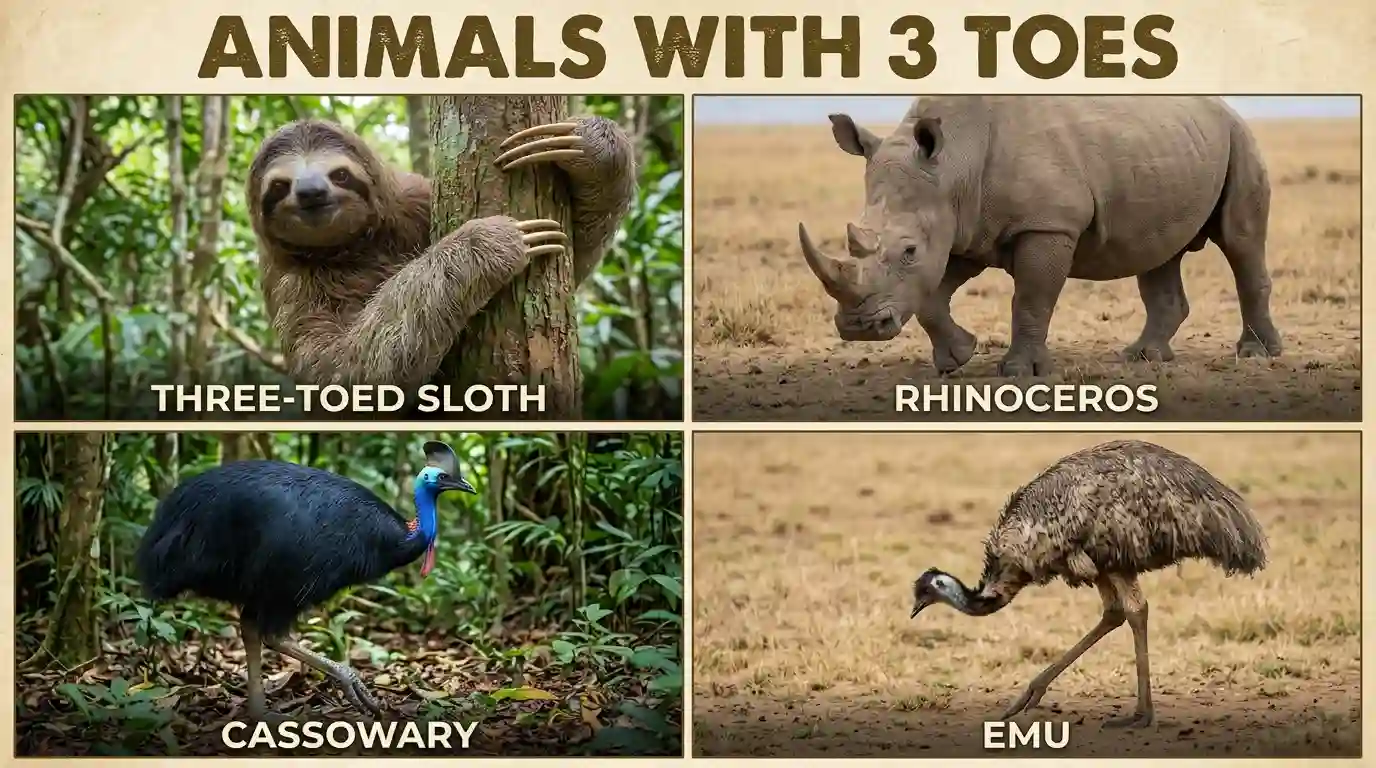
Which animals have three toes? The best-known answers are rhinoceroses, three-toed sloths, emus, rheas, cassowaries, bustards, and the three-toed box turtle. Tapirs also have three toes, but only on their hind feet. Most mammals have five toes and horses have one, so three toes is a rare middle ground. This guide gives the names of animals that have 3 toes, shows where they live, and explains why they evolved this way. It also covers how to read a three-toed track and which animals have webbed feet.

What Does “Three-Toed” Mean?
Biologists call the condition tridactyly. It means having three digits on a limb, as in rhinoceroses and early horse ancestors such as Protohippus and Hipparion.
A few related terms help when you read about toes:
- Digit: a toe or finger.
- Hallux: the small rear toe, like a big toe, found in many birds.
- Anisodactyl: the most common bird foot, with three toes pointing forward and one back.
- Bidactyly: having two toes, as in the ostrich.
“Three-toed” can also describe a track rather than an animal. A bird with four toes can leave a three-toed print if the hallux is small or sits too high to touch soft ground. So it helps to know both the anatomy and the footprint.

Names of Animals That Have 3 Toes (Quick List)
Here is a quick answer for anyone who just wants the names of animals that have 3 toes.
- Mammals: rhinoceros, three-toed sloth, northern three-toed jerboa, tapir (hind feet only)
- Birds: emu, rhea, cassowary, bustard, sanderling, three-toed woodpeckers, three-toed swiftlet, three-toed parrotbill
- Reptiles: three-toed box turtle, western three-toed skink
- Amphibians: three-toed amphiuma, three-toed toadlets
- Extinct: early horses such as Merychippus and Hipparion, and many theropod dinosaurs
If you only need 3 animals that have feet with three toes, the easiest picks are the rhinoceros, the emu, and the three-toed sloth. The sections below explain each one.
Why Do Some Animals Have Three Toes?
Fewer toes usually mean a more specialized body. Three toes have evolved separately in very different animals, for three main reasons:
- Carrying weight. In heavy animals, a few strong toes with a thick pad handle the load better than many small ones.
- Running. Lighter feet with fewer bones are quicker to swing, which suits fast runners on open ground. Emus, for example, cut weight at the end of the leg while keeping traction.
- Gripping. Long curved claws, or a toe layout built for bark, help climbers and perchers hold on.
Mammals With Three Toes
Rhinoceroses: The Animal With 3 Toes and a Pad
If you are wondering what animal has 3 toes and a pad, the rhinoceros is the clearest answer. The name comes from Greek words meaning “nose-horn.” All five rhino species have three toes on each foot, with a broad padded sole under them. In odd-toed ungulates, the body weight rests on the middle toe. The pad spreads the load across the foot, which is how an animal weighing over a tonne walks on such small feet.

Tapirs
Tapirs are a partial answer. They have four toes on the front feet and three on the hind feet. The Malayan tapir lives in Southeast Asia, and the other three species live in Central and South America. Their splayed toes help on soft, muddy forest floors, and they are also good swimmers.

Three-Toed Sloths
The three-toed sloth (Bradypus) has three long, curved claws on each limb, which work like hooks for hanging from branches. There are four species: the brown-throated, pale-throated, maned, and pygmy three-toed sloths. The “two-toed” and “three-toed” names refer only to the front limbs. All sloths have three toes on their hind feet, so the real difference is two claws or three on the forelimbs.
Extra vertebrae in the neck let a three-toed sloth turn its head a very long way without moving its body. It spends most of the day asleep in the canopy, and a single meal can take up to a month to digest.

Jerboas
The northern three-toed jerboa is a small desert rodent with three toes on its hind feet. Its feet suit hopping across loose sand.

The Order Behind the Mammals: Odd-Toed Ungulates
Rhinos and tapirs belong to the order Perissodactyla, the odd-toed ungulates. The group also includes horses and zebras, which stand on a single toe. What unites them is that most weight rests on the third, middle toe. Even-toed ungulates such as deer, cattle, pigs, and camels share weight between two toes instead.
Birds With Three Toes
Birds are bipeds, which makes them the best-known animals having two feet, so the shape of each foot decides how well they run, perch, or wade. Most birds are anisodactyl, with three toes forward and one back. Three-toed birds either lack the hind toe or have lost one of the usual four. Birds are also the only living animals with true feathers, so emus, rheas, and cassowaries below are good examples of animals that have feathers and three toes.
Emu
The emu is native to Australia and is the second tallest living bird. It has three forward-facing toes, which give it traction for fast running and powerful kicks. Its dense plumage also insulates its skin and helps it avoid overheating. The ostrich, by comparison, has only two toes.

Rhea
Rheas are flightless birds of South American grasslands. Like emus, they have three toes, which help them run from predators across open ground.
Cassowary
Cassowaries live in the rainforests of northern Australia and New Guinea. They have three toes, and the inner toe carries a long, dagger-like claw. Their tracks are large and deeply pressed into the soil.

Bustards
Bustards are large ground birds of Africa, Europe, Asia, and Australia. They have three forward-pointing toes and no hind toe, and their short, broad toes are suited to running.
Three-Toed Woodpeckers
Most woodpeckers have four toes, two forward and two back. The American three-toed woodpecker (Picoides dorsalis) and the Eurasian three-toed woodpecker have lost one back toe. They live in northern forests, cling to bark, and feed on beetles.

Other Three-Toed Birds
The sanderling is a shorebird that lacks a hind toe and runs along the surf line on three toes. The three-toed swiftlet of New Guinea is a small swift with three toes. The three-toed parrotbill of central China grips bamboo stems. Buttonquails also lack a hind toe, but true quails usually have a small one, so quail counts depend on the species.
Reptiles and Amphibians With Three Toes

Three-Toed Box Turtle
The three-toed box turtle (Terrapene carolina triunguis) lives in the south-central United States. It usually has three toes on its hind feet, though the count can vary between individuals. Its broad feet and claws are made for land, not swimming, and it can live for more than 50 years.
Western Three-Toed Skink
This lizard (Chalcides striatus) lives in southwestern Europe, including Spain, southern France, Portugal, and northwest Italy. It has tiny three-toed limbs and a long body, and in grass it moves much like a snake.
Three-Toed Amphiuma
This eel-like salamander (Amphiuma tridactylum) lives in the swamps and slow waters of the southern United States. It has very small limbs with three toes each and spends nearly all its life in the water.
Three-Toed Toadlets
Some toadlets in Brazil’s Atlantic Forest have reduced toes, and many species have only three. They are tiny frogs, not true toads, and they hatch directly as miniature adults without a tadpole stage.
Extinct Three-Toed Animals
Fossils show three toes appearing over and over in the past.
- Early horses. Today’s horse has one toe, but its ancestors reduced theirs step by step. Merychippus and Hipparion walked on three toes, with the middle one carrying most of the weight. Even earlier horses had four toes on the front feet and three on the hind, much like tapirs do today.
- Theropod dinosaurs. Most walked on three main toes, with a small hind toe often held off the ground, which is why their tracks look so much like bird prints. Some fast runners, such as ornithomimids, reduced their toes to just three.
Three Toes Compared to Other Toe Counts
| Toe count | Examples |
|---|---|
| 1 | Horses, zebras, donkeys |
| 2 | Ostriches, camels, deer, cattle |
| 3 | Rhinoceroses, emus, rheas, cassowaries, three-toed sloths (on the forelimbs) |
| 4 | Most birds (3 forward, 1 back), pigs, dogs, cats |
| 5 | Humans, bears, raccoons, most rodents |
Animals That Have 3 Toes in the World: Where They Live
Animals that have 3 toes in the world are spread across almost every continent, from African savannas to Australian rainforests and North American swamps.
| Region | Examples |
|---|---|
| Africa | Black and white rhinos, bustards |
| Asia | Indian, Javan, and Sumatran rhinos, Malayan tapir, jerboas, three-toed parrotbill |
| Europe | Western three-toed skink, Eurasian three-toed woodpecker |
| North America | American three-toed woodpecker, three-toed box turtle, three-toed amphiuma |
| Central and South America | Tapirs, three-toed sloths, rheas, three-toed toadlets |
| Australia and New Guinea | Emu, cassowary, three-toed swiftlet |
Animal Tracks With 3 Toes: How to Identify Them
Finding a three-toed print is common. Besides the odd-toed mammals (rhinos, tapirs, and horses), most other animals that leave three-toed prints are birds. In most places outside Africa and Asia, you are likely looking at a bird.
Step 1: Check the size. Place a coin or ruler beside the print and photograph it. Small prints belong to shorebirds, quail, or small birds. Medium prints often belong to turkeys, herons, or geese. Very large, round prints with blunt lobes point to a rhino, and large deep prints in rainforest soil could be a cassowary.
Step 2: Look at the toe layout. Bird tracks usually show three toes fanning forward, sometimes with a thin rear toe. A rhino print shows three broad lobes with a wide pad behind them.
Step 3: Look for webbing. Connected toe pads mean a water bird. Ducks, geese, and gulls have three webbed forward toes and a small hind toe that rarely prints. Pelicans and cormorants webb all four toes, so their prints look different.
Step 4: Look for claw marks. Sharp points at the toe tips suggest a bird or reptile. Rounded hoof-like edges suggest a mammal.
Step 5: Check for a drag line. A dragged tail between the prints points to a reptile.
Step 6: Follow the trail. One print can mislead, but a line of prints shows stride and pattern. Birds usually leave a left-right alternating trail.
Step 7: Note the habitat. A muddy riverbank, a sandy beach, a forest trail, and a backyard lawn each narrow the list quickly. Raccoons also leave muddy riverbank tracks, but their prints show five long fingers, so they are easy to rule out.

Track Pictures to Compare
If you are searching for animal tracks with 3 toes pictures, compare your photo against these common patterns:
| Track picture | What to look for | Likely animal |
|---|---|---|
| Thin three-pronged fan, small | Sharp tips, thin rear mark | Songbird, quail, shorebird |
| Three toes joined by a web | Skin-like outline between toes | Duck, goose, gull |
| Three long toes with a long stride | Large, widely spaced prints | Heron, turkey |
| Three broad blunt lobes with a wide pad | Round and very large | Rhino |
| Three deep toes with a heavy claw mark | Large, forest soil | Cassowary |
Which Animals Have Webbed Feet?
Webbed feet are often mixed up with three-toed feet, because many webbed-footed birds leave three-toed prints.
Webbed feet animals meaning: webbed feet are feet where the toes are joined by a thin skin membrane. The membrane acts like a paddle, helping the animal swim, push through soft mud, or walk on soft surfaces like wet sand.
Which animal has webbed feet? Common examples include:
- Birds: ducks, geese, swans, gulls, pelicans, and penguins
- Mammals: otters, beavers, and the platypus
- Amphibians: most frogs
- Reptiles: some turtles and the Namib web-footed gecko
Three animals that have feet with very obvious webbing are the duck, the otter, and the frog, so they make good starting points for a comparison.
Webbed feet animals pictures: to confirm webbing in a photo, look for skin stretched between the toes. Duck and goose feet show three webbed toes, while pelican and cormorant feet show webbing across all four.

Conservation Status
Several three-toed animals are under pressure. Rhino species range from near threatened (white rhino) to critically endangered (black, Javan, and Sumatran rhinos), mostly because of poaching and habitat loss. Three of the four tapir species are listed as endangered. Among sloths, the pygmy three-toed sloth is critically endangered and lives only on one small island off Panama. Check the IUCN Red List for the current status of any species.
FAQs
Rhinoceroses, emus, rheas, cassowaries, bustards, three-toed sloths (on the forelimbs), and the three-toed box turtle are all common examples. Tapirs have three toes only on their hind feet.
Rhinoceroses, emus, rheas, cassowaries, and the three-toed sloth are the most common answers. A three-toed print on the ground is usually a bird’s.
The rhinoceros fits best, with three toes on each foot and a broad padded sole.
Yes. Rhinoceroses and the three-toed sloth do, and tapirs have three toes on their hind feet.
Emus, rheas, cassowaries, bustards, sanderlings, and the American and Eurasian three-toed woodpeckers.
Both are sloths, but they belong to separate, distantly related lineages. Their similar tree-hanging lifestyle evolved independently.
Ducks, geese, swans, frogs, otters, beavers, and the platypus all have webbed feet.
No living species normally has seven toes. Extra toes can appear as a genetic variation called polydactyly, as in some cats. Early four-legged animals such as Ichthyostega and Acanthostega had as many as eight toes.
Conclusion
Animals that have 3 toes show up in almost every part of the animal kingdom, from heavy rhinos and fast emus to tiny skinks and toadlets. Each design reflects how the animal lives, whether it carries great weight, runs from predators, or grips a branch. If you find a three-toed print, measure it, check for webbing and claws, and think about the habitat, and you will have a good chance of working out who made it.

Daniel Parker is an animal and wildlife writer who enjoys exploring the fascinating world of animals and birds. He writes about animal behavior, diets, physical features, habitats, and the unique traits that make different species interesting. His goal is to turn animal facts into simple, enjoyable guides that are easy for anyone to understand.
