


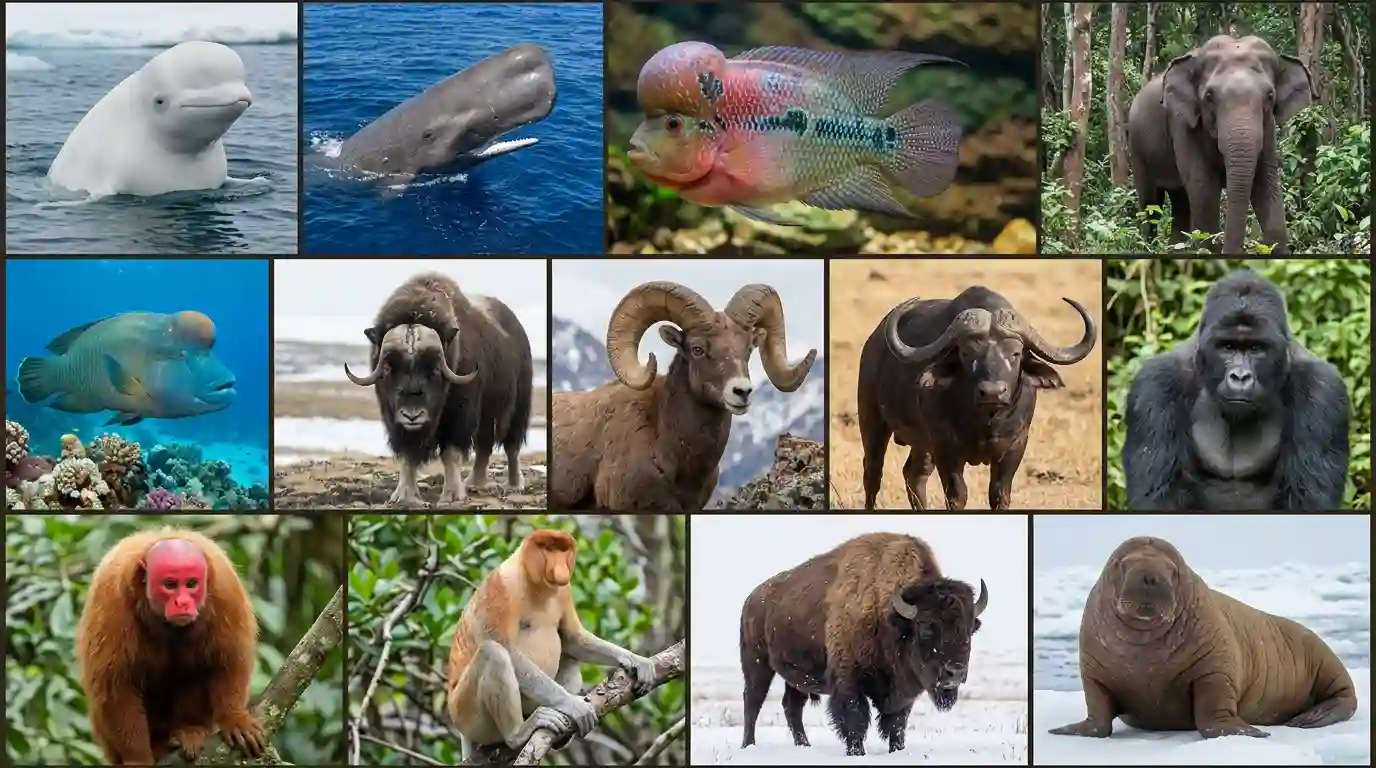

Some animals have large, rounded foreheads that make them easy to recognize. Beluga whales have soft, bulb-shaped foreheads, while musk oxen have thick, protective structures across the front of their heads. Some fish also develop noticeable forehead humps as they grow.
These features are not all the same. Some help animals focus sound, while others are linked to protection, body structure, or social displays.
This guide explores 10 animals with big foreheads, explains what makes their heads unusual, and shares interesting facts about their appearance and behavior.
Do Animals Have Foreheads?
Yes, many animals have a forehead area. However, an animal’s forehead does not always look like a human forehead.
In mammals, the forehead is generally the front part of the head above the eyes. In whales and dolphins, a rounded structure called the melon sits on the front of the head. Some fish develop fleshy or bony humps, while animals such as musk oxen have strong skull structures beneath their horns.
These features have different shapes and purposes. A large forehead may help with sound production, protection, or social displays. In other animals, it is simply part of their natural head shape.
How Different Animals Develop Big Foreheads
Not all big foreheads have the same structure. Some are made of specialized fatty tissue, while others involve bone, muscle, or thick skin.
| Animal | Forehead Feature | Main Role or Possible Function |
|---|---|---|
| Beluga whale | Fatty melon | Focuses sound for echolocation and may support visual displays |
| Sperm whale | Spermaceti organ | A specialized head organ involved in sound-related biology |
| Bottlenose dolphin | Fatty melon | Helps focus sound during echolocation |
| Asian elephant | Large, rounded head | Part of its skull structure |
| Humphead wrasse | Large forehead hump | Distinctive body feature associated with maturity |
| Midas cichlid | Nuchal hump | Becomes more noticeable in some individuals |
| Flowerhorn cichlid | Fleshy kok | Developed through selective breeding |
| Musk ox | Thick horn boss over the skull | Helps protect the head during clashes |
| Bighorn sheep | Strong skull and horns | Helps withstand impacts during head-butting |
| African buffalo | Horn boss | Forms a thick protective structure across the forehead |
10 Animals With Big Foreheads
1. Beluga Whale
The beluga whale (Delphinapterus leucas) is one of the best-known sea animals with a big forehead. It has a smooth, rounded bulge on the front of its head. This structure is called the melon.

The melon contains fatty tissue and helps focus sound during echolocation. Belugas use echolocation to find food, explore their surroundings, and detect objects in dark or icy water.
Beluga whales are also known as white whales. Adults usually have white skin, which helps them blend into their Arctic and sub-Arctic surroundings. They are social animals and often travel in groups.
One unusual feature makes their forehead especially interesting. Belugas can change the shape of their melon. A 2024 study identified five different melon shapes and found that these shapes appeared much more often during social interactions. The researchers suggested that the movements may work as visual displays, although more research is needed to understand their full meaning.
Interesting fact: Belugas are sometimes called the canaries of the sea because they produce a wide range of sounds.
Image caption: A beluga whale showing its rounded melon, the soft structure on the front of its head.
2. Sperm Whale
The sperm whale (Physeter macrocephalus) has one of the largest and most unusual heads in the animal kingdom. Its enormous, block-shaped head can make up a large part of its body length.

Inside the head is a specialized structure called the spermaceti organ. It contains a waxy substance known as spermaceti. Scientists have studied this organ for many years because of its connection to the whale’s sound-producing system.
Its exact role is complex and should not be reduced to one simple explanation. The spermaceti organ is associated with the sperm whale’s powerful clicking sounds and sound-related biology.
Sperm whales use clicks for echolocation. These sounds help them locate prey, including deep-sea squid. They can dive to great depths while searching for food.
Interesting fact: Sperm whales have the largest brains of any known animal, measured by mass.
Image caption: A sperm whale with its massive, square-shaped head above the ocean surface.
3. Bottlenose Dolphin
The bottlenose dolphin (Tursiops truncatus) is another animal with a noticeable forehead. Its head has a rounded melon above its long, narrow snout.

The melon is made of fatty tissue. It helps focus sound waves that dolphins use for echolocation. This ability allows them to detect fish, objects, and other animals underwater.
Bottlenose dolphins are intelligent, social mammals. They live in groups, communicate through sounds, and use different hunting techniques. Their rounded forehead gives them a distinctive appearance.
People sometimes search for the name of a dolphin with a big forehead. The bottlenose dolphin is a familiar example, but it is not the only dolphin with a melon. Many toothed whales have this specialized structure.
Interesting fact: Bottlenose dolphins can recognize individual whistles and use sounds to communicate with one another.
Image caption: A bottlenose dolphin showing the rounded forehead area known as the melon.
4. Asian Elephant
The Asian elephant (Elephas maximus) has a large head with a broad, rounded forehead. Its head looks different from that of many other land mammals because of its size, shape, and powerful skull structure.

The forehead is part of the elephant’s overall head anatomy. It supports the large skull and the muscles and tissues needed for everyday movement.
Asian elephants use their trunks to pick up food, drink water, smell, touch objects, and communicate. Their large heads also support their strong jaws and other important structures.
Asian elephants live in forests and grasslands across parts of South and Southeast Asia. They are social animals and often form family groups led by an older female.
Interesting fact: An elephant’s trunk contains tens of thousands of muscle units, giving it remarkable strength and control.
Image caption: An Asian elephant showing its broad forehead and large, rounded head.
5. Humphead Wrasse
The humphead wrasse (Cheilinus undulatus) is a large reef fish known for its thick lips and prominent forehead hump. It is also called the Napoleon wrasse.

As this fish grows, the hump on its head becomes more noticeable. Adult males often develop a particularly prominent forehead. This feature gives the species its unusual appearance.
Humphead wrasses live around coral reefs in the Indo-Pacific region. They feed on a variety of marine animals, including mollusks and crustaceans. Their strong teeth help them handle hard-shelled prey.
The species is threatened by overfishing and damage to coral reef habitats. Protecting reef ecosystems is important for its survival.
Interesting fact: Humphead wrasses can change sex during their lives. Some females become males as they mature.
Image caption: A humphead wrasse, also known as the Napoleon fish, showing its large forehead hump.
6. Midas Cichlid
The Midas cichlid (Amphilophus citrinellus) is a freshwater fish native to Central America. It is known for its strong body, bright colors, and noticeable forehead hump.

The hump, also called a nuchal hump, can become more prominent in some adult fish. Its size and shape vary between individuals. It may be linked to maturity and social behavior, but it should not be treated as a feature that every Midas cichlid develops equally.
Midas cichlids live in freshwater lakes and other suitable habitats. They feed on a varied diet that can include small fish, insects, and other aquatic food.
Their appearance has also made them popular in the aquarium trade. They are strong and territorial fish, so they need suitable space and care.
Interesting fact: Midas cichlids are closely related to other Central American cichlids, including fish used in the development of some aquarium hybrids.
Image caption: A Midas cichlid with a noticeable nuchal hump on its forehead.
7. Flowerhorn Cichlid
The flowerhorn cichlid is a popular ornamental aquarium fish known for its colorful body and large forehead growth. This rounded growth is commonly called a kok.

Unlike a natural feature found in one wild species, the flowerhorn is a hybrid fish developed through selective breeding. Its appearance can vary widely depending on its breeding line.
Some flowerhorns have large, rounded koks, while others have smaller forehead growths. Their bright colors and unusual head shapes make them popular among aquarium enthusiasts.
Flowerhorns need large tanks, clean water, proper filtration, and a suitable diet. They can also be territorial, so choosing tank companions requires care.
Interesting fact: The size and shape of a flowerhorn’s kok can vary as the fish grows.
Image caption: A flowerhorn cichlid displaying its colorful body and prominent forehead kok.
8. Musk Ox
The musk ox (Ovibos moschatus) is a large Arctic mammal with a strong head and thick horns. Its forehead is covered by a tough, thick structure called the horn boss, formed where the bases of the horns meet across the skull.

The horn boss lies between and above the bases of the horns. It helps protect the front of the skull when musk oxen clash heads. These animals sometimes charge and strike one another during fights, especially when competing for dominance.
Musk oxen live in cold Arctic regions of Greenland, Canada, and Alaska. Their thick coats help them survive freezing temperatures and strong winds.
They also have a soft undercoat called qiviut. This wool-like layer provides excellent insulation against the cold.
Interesting fact: Musk oxen can form a defensive circle around their young when predators approach.
Image caption: A musk ox showing its thick forehead and strong horns.
9. Bighorn Sheep
The bighorn sheep (Ovis canadensis) is known for its large, curved horns and strong skull. Its forehead is built to handle the powerful impacts that occur when males clash during competition.

Male bighorn sheep, called rams, use their horns in fights to establish dominance and gain access to mates. Their skulls and neck muscles help them withstand these impacts.
Bighorn sheep live in mountainous regions and rocky habitats across western North America. Their sure-footed movement helps them climb steep slopes and escape predators.
Their horns grow throughout their lives and develop distinctive curves. The size and shape of the horns can help indicate an animal’s age.
Interesting fact: Bighorn sheep can climb steep rocky surfaces that many other large mammals would struggle to cross.
Image caption: A bighorn sheep ram with large curled horns and a strong forehead.
10. African Buffalo
The African buffalo (Syncerus caffer) is a powerful grassland and woodland mammal. It has a large head with a thick structure called a horn boss.

The horn boss forms where the bases of the horns meet across the forehead. In adult males, it can become especially thick and strong. This structure helps protect the skull during fights and clashes.
African buffaloes live in different habitats across sub-Saharan Africa, including savannas, grasslands, and woodlands. They usually travel in herds and feed on grasses.
Their strong bodies, curved horns, and protective head structures make them well suited to life in the wild.
Interesting fact: African buffaloes often form large herds that help protect members from predators.
Image caption: An African buffalo showing its broad forehead and thick horn boss.
Other Animals With Noticeable Foreheads
The 10 animals above are clear examples, but several other species also have unusual head shapes.
- Orangutans: Adult male orangutans may develop large cheek pads called flanges, which change the shape of the face.
- Gorillas: Their strong brow ridges and large skulls give the head a powerful appearance.
- Bald uakaris: These monkeys have distinctive bright red faces and a rounded head.
- Proboscis monkeys: Their large noses are their most noticeable facial feature, rather than a forehead hump.
- American bison: They have a large shoulder hump and a broad head, but the shoulder hump should not be confused with a forehead.
- Walruses: Their broad heads and thick whiskers give them a distinctive appearance.
- Elephant seals: Their large bodies and, in adult males, enlarged noses make them easy to recognize.
- Oranda goldfish: They develop a fleshy head growth known as a wen.
- Green humphead parrotfish: This reef fish has a rounded forehead and a strong beak-like mouth.
- Beluga sturgeon: It has a long body and unusual head shape, but it should not be confused with the beluga whale.
These examples show that a large-looking forehead can come from different body structures. A cheek pad, brow ridge, fatty melon, and fleshy head growth are not the same thing.
Why Do Some Animals Have Big Foreheads?
Animals develop different head shapes through evolution, growth, and adaptation. A large forehead does not have one universal purpose.
Some structures help animals sense their surroundings. For example, the melon of a beluga whale or bottlenose dolphin helps focus sound during echolocation.
Other structures provide protection. Musk oxen have a thick horn boss, while bighorn sheep have skulls adapted to withstand head impacts.
In some fish, forehead growths become more noticeable as the animal matures. The Midas cichlid can develop a nuchal hump, while flowerhorn cichlids have a fleshy kok shaped by selective breeding.
A large forehead can also be part of an animal’s natural appearance without having one clearly established function. Scientists study these features to understand how animals grow, communicate, feed, and survive.
Big Forehead Animals Pictures and Images
Pictures make it easier to compare animals with unusual head shapes. When looking at big forehead animals pictures, pay attention to the exact structure rather than judging only by the size of the head.
For example, a beluga whale has a soft, rounded melon, while a musk ox has a strong bony structure between its horns. A flowerhorn cichlid has a fleshy kok, which is different from the melon of a whale.
For a useful image collection, choose clear photographs that show the animal’s head from the side or front. Use images that are properly licensed or that you have permission to publish.
Frequently Asked Questions
Beluga whales, sperm whales, bottlenose dolphins, Asian elephants, humphead wrasses, Midas cichlids, flowerhorn cichlids, musk oxen, bighorn sheep, and African buffaloes. Their forehead structures differ: fatty melons, bony or horn-based structures, or fleshy growths.
The sperm whale has one of the largest heads, containing the spermaceti organ. There is no standard measurement, so the answer depends on what you compare.
Their rounded melon is made of fatty tissue and helps focus sound for echolocation. A 2024 study found belugas also change its shape during social interactions, which may act as a visual display.
Beluga whales, sperm whales, bottlenose dolphins, humphead wrasses, and green humphead parrotfish. Whales and dolphins have a melon, while reef fish have a solid forehead hump.
The bottlenose dolphin is a familiar example. Its melon focuses sound for echolocation, but many toothed whales and dolphins have one too.
It is a humorous online phrase, not a separate species. Some images exaggerate a dolphin’s head, which naturally has a melon.
It is an informal meme-style description, not a species name. Identify the actual animal from reliable details rather than from the phrase.
Dragonflies. Their compound eyes have around 28,000 tiny units called ommatidia, not 28,000 separate eyeballs.
No. Intelligence depends on brain size, structure, and behavior. A large forehead may hold only fat, bone, or horn.
Conclusion
Animals with big foreheads come in many shapes and sizes. Beluga whales use a fatty melon to focus sound, while musk oxen and bighorn sheep have strong head structures that help protect them during physical clashes. Some fish also develop large forehead growths as they mature or through selective breeding.
These features show how different animals have developed unique head shapes. Looking closely at their anatomy helps explain not only what makes them unusual but also how they live and survive in their environments.

Daniel Parker is an animal and wildlife writer who enjoys exploring the fascinating world of animals and birds. He writes about animal behavior, diets, physical features, habitats, and the unique traits that make different species interesting. His goal is to turn animal facts into simple, enjoyable guides that are easy for anyone to understand.
