


Ask people which animal has the thickest skin and most will say elephant, rhino or hippo. It’s a fair guess, and it’s wrong. The record belongs to a gentle giant of the open ocean. Along the way, though, the story gets more interesting: some animals have skin that’s thick, some have skin that’s tough, and some are padded with blubber that gets mistaken for skin.
This guide sorts it all out. You’ll find the record holder, the thickest land animal, a side-by-side look at rhino, hippo and elephant, how thick skin actually works, and a few surprises, from extinct armored giants to technology inspired by shark skin.

Which Animal Has the Thickest Skin?
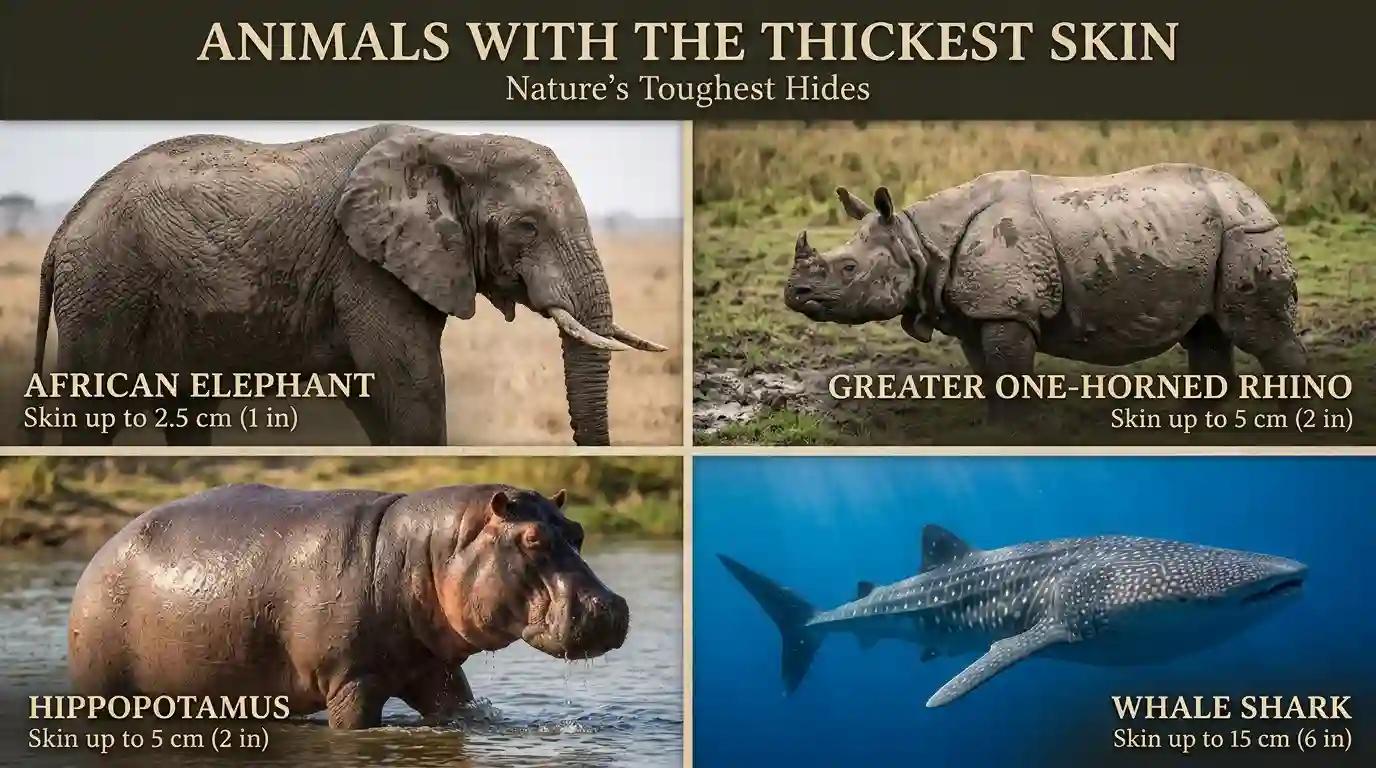
The whale shark (Rhincodon typus) has the thickest skin of any living animal. According to Guinness World Records, its skin is typically around 10 cm (4 in) thick, and that holds true on land or in the sea. Discover Wildlife gives the same figure and adds that the skin is hard and rough to the touch, covered in dermal denticles: tiny, tooth-like scales that cut down drag as the shark swims.
If you came across a quiz question like “which of the following animals has the thickest skin: elephant, rhino, hippo or whale shark?”, the answer is the whale shark.
Which Land Animal Has the Thickest Skin?
On land, the hippopotamus (Hippopotamus amphibius) is most often credited with the thickest skin, at roughly 4 to 6 cm (1.5 to 2.4 in). The rhinoceros follows at roughly 1.5 to 5 cm, depending on the species and body part. The elephant comes in at about 2.5 to 3 cm in its thickest areas.
Sources disagree a little, and that’s normal. Skin thickness changes with age, sex and body region, so treat every number here as an approximate range.
| Animal | Approx. Skin Thickness | Notes |
|---|---|---|
| Whale shark | ~10 cm (4 in) | Thickest of any living animal (Guinness World Records) |
| Hippopotamus | ~4 to 6 cm (1.5 to 2.4 in) | Thickest among land mammals in most sources |
| Rhinoceros | ~1.5 to 5 cm (0.6 to 2 in) | Varies by species and body part |
| Elephant | ~2.5 to 3 cm (1 to 1.2 in) | Far thinner around ears, eyes and mouth |
| Human, for comparison | ~1 to 2 mm on average | Thickest on palms and soles |
Whales, walruses and elephant seals aren’t in this table on purpose. The next section explains why.
Skin vs. Blubber: Why Whale Numbers Look So Big
You’ll often read that a sperm whale or blue whale has skin “up to a foot thick.” Those figures usually add skin and blubber together. Blubber is a layer of fat that insulates the body, stores energy and helps with buoyancy. It’s essential, but it isn’t skin.
The same goes for walruses and elephant seals. They have thick, tough skin, but much of their measured “thickness” is blubber. That’s exactly why the whale shark wins: its 10 cm is skin all the way through.
Top 5 Thickest Skin Animals
- Whale shark: about 10 cm, the record holder.
- Hippopotamus: about 4 to 6 cm, the thickest on land.
- Rhinoceros: about 1.5 to 5 cm, with armor-like folds.
- Elephant: about 2.5 to 3 cm, wrinkled and surprisingly sensitive.
- Crocodile: not the thickest by measurement, but arguably the toughest thanks to its bony plates.

Top 10 Thickest Skin Animals
Only the first four are ranked by measured thickness. The rest are included because their hides are unusually thick or tough, so read positions 5 to 10 as the “most notable” rather than a strict ranking.
- Whale shark
- Hippopotamus
- Rhinoceros
- Elephant
- Crocodile
- Walrus
- American bison
- Wild boar
- Grizzly bear
- Honey badger
A few more nearly made the list: the Cape buffalo, camel, giraffe, warthog, manatee, armadillo and elephant seal.
Rhino vs. Hippo vs. Elephant: Whose Skin Is Really Thicker?
Short answer: the hippo and rhino generally beat the elephant on raw thickness. Between the hippo and rhino, the hippo usually has a slight edge. But thickness only tells half the story.
| Rhinoceros | Hippopotamus | Elephant | |
|---|---|---|---|
| Approx. thickness | ~1.5 to 5 cm | ~4 to 6 cm | ~2.5 to 3 cm |
| Structure | Dense, layered collagen with armor-like folds | Thick dermis, very little hair | Deep wrinkles that hold mud and water |
| Skin secretion | None notable | Reddish “blood sweat” | None notable |
| Main weakness | Sunburn, insects | Cracks and dries out of water | Thin, sensitive skin on ears and mouth |
Wildlife vets have noticed something telling. A newsletter from Wildlife Vets Namibia notes that rhino skin is harder to inject through than elephant skin, even though elephant skin can be thicker in places. The reason is structure. Rhino skin is built from tightly packed, layered collagen fibers, which makes it dense in a way that thickness alone doesn’t capture.
So who has thick skin, rhino or hippo? Both do, just in different ways. The hippo’s is thicker, and the rhino’s is harder to get through.
What Is a Thick-Skinned Animal Called?
The classic word is pachyderm, from Greek roots meaning “thick skin.” It was traditionally used for elephants, rhinoceroses and hippopotamuses, and for a long time naturalists treated them as one group.
Modern biology doesn’t. These animals aren’t close relatives, and they developed thick skin independently. The word survives in everyday language, though, which brings us to the idiom: to be “thick-skinned” now means you don’t get easily upset by criticism, while someone “thin-skinned” is easily hurt. The phrase borrows the image of a tough hide that things bounce off.
Meet the Thickest Skin Animals
Whale Shark
Beyond its thickness, whale shark skin carries a spot-and-stripe pattern that’s unique to each individual, like a fingerprint. Researchers use these patterns to identify and track individual sharks over the years.

Hippopotamus
Hippo skin is thick but surprisingly delicate. It dries and cracks in the sun, so hippos spend most of the day in rivers and lakes across sub-Saharan Africa. Their skin also produces a reddish oily fluid nicknamed “blood sweat.” It isn’t blood or sweat. We’ll get to what it actually is a little further down.
Rhinoceros
The white rhinoceros (Ceratotherium simum) and Indian rhinoceros (Rhinoceros unicornis) both have collagen-rich skin that forms heavy folds like armor plates. The Indian rhino, from northern India and Nepal, looks the most armored. In reality those “plates” are flexible skin supported by dense connective tissue, which is how rhinos move so easily. Rhino calves are born with softer skin that thickens and folds as collagen matures.
Elephant
The African elephant (Loxodonta africana) and Asian elephant (Elephas maximus) have skin around 2.5 cm thick in many areas. Deep wrinkles hold water and mud, helping with thermoregulation. Despite the thickness, elephant skin is full of nerve endings and very sensitive to touch.
Crocodile
Nile crocodiles and saltwater crocodiles have osteoderms, bony plates embedded in the skin that work like built-in body armor. Their skin also holds sensory organs that pick up vibrations in the water.
Walrus and Elephant Seal
Both pair thick skin with blubber. The walrus (Odobenus rosmarus) gets protection from Arctic cold and sharp sea ice, and its scarred, wrinkled hide shows years of fighting. Male elephant seals develop an extra-thick, reinforced neck and chest that works like armor during breeding battles.

Bison and Cape Buffalo
The American bison’s thick hide sits under a shaggy coat and absorbs the shock of head-to-head clashes. The Cape buffalo’s hide isn’t as thick as a rhino’s, but it resists punctures well, which matters when lions are involved.
Wild Boar and Warthog
Adult male wild boars grow a fibrous “shoulder shield” under the skin that protects vital organs from rivals’ tusks. Warthogs have a tough, mostly bare hide that guards against thorns and tusk wounds.

Grizzly Bear
A thick hide backed by a layer of fat beneath dense fur helps the grizzly handle fights with rivals, thorny undergrowth and freezing winters.
Camel and Giraffe
The camel’s tough hide protects against abrasive sand and intense sun. People have used camel leather for shoes, bags and traditional tents for generations. Giraffe skin isn’t among the thickest, but it handles thorny savanna vegetation well, and each animal’s coat pattern is unique.
Honey Badger
Small, but legendary. Its loose, thick skin lets it twist around and bite back even when a predator has a firm grip, and it helps against bites and bee stings.

Others Worth Knowing
The manatee has thick, flexible skin that constantly renews itself. The sperm whale carries scars from giant squid beneath its wrinkled skin. The moose and gaur have thick hides suited to cold northern forests and dense Asian jungles.
Hard Skin Animals List
If what you want is hard or armored skin rather than simply thick skin, these are the standouts:
- Crocodiles and alligators: skin reinforced with osteoderms.
- Armadillos: bony plates covered in keratin, more shell than skin.
- Pangolins: overlapping keratin scales.
- Rhinoceroses: collagen-dense skin in armor-like folds.
- Leatherback sea turtles: leathery skin over a mosaic of tiny bony plates.
- Tortoises and turtles: a bony shell covered in hard plates called scutes.
How Thick Skin Actually Works
Skin has three main layers. The epidermis is the outer barrier, the dermis underneath holds collagen, nerves and blood vessels, and the hypodermis below that stores fat and anchors the skin to the body.
In most thick-skinned animals, the thickness comes mainly from the dermis. A dense mesh of collagen fibers gives the skin its strength, and how those fibers are arranged matters as much as how many there are. That’s the difference between rhino skin and elephant skin.
Other animals build their armor with different materials:
- Keratin, the same protein in hair and nails, forms the scales of pangolins and the plates of armadillos.
- Osteoderms, small bones set into the skin, protect crocodiles and leatherback turtles.
- Blubber adds insulation and padding, but sits beneath the skin rather than being part of it.
Measuring all this isn’t simple. Researchers typically rely on skin samples or measurements taken from specimens, and the result depends on where on the body they measure, the animal’s age and its sex. That’s why you’ll see slightly different numbers from source to source, and why this article uses ranges.
Thick vs. Tough: Not the Same Thing
Thick skin is about depth. Tough skin is about how well it resists damage. The hippo has some of the thickest skin on land, yet it cracks and burns if it dries out. Crocodile skin is thinner in places, but bony osteoderms make it extremely hard to penetrate. That’s why the crocodile often gets named as having the toughest skin, even though it doesn’t hold the thickness record.
What About Skin Thickness Relative to Body Size?
There’s no standard way to measure this, so be wary of any “ranking.” In absolute terms, big animals win. Relative to body size, small animals like the honey badger and armadillo are often highlighted for having unusually tough protection, since they rely on their skin and armor rather than size to survive.
Why Do Animals Evolve Thick Skin?
Thick skin is the product of natural selection over millions of years. It helps animals with:
- Fighting and defense: fewer injuries from predators and rival males.
- Rough surroundings: thorns, rocks and sea ice all take a toll.
- Biting insects and parasites: a tougher barrier is harder to break through.
- Climate and water balance: wrinkles, mud and dust baths help regulate temperature.
- Sheer size: big animals can’t easily hide or outrun trouble.
It isn’t free, though. Thick skin is heavy, costs energy to build and can trap heat. That’s why so many thick-skinned animals also evolved wrinkles, big ears, mud-wallowing habits or a life in the water.
Life Inside a Thick Hide
Thick skin solves some problems and creates new ones. Here’s how real animals deal with them.
Parasites and insects. Even a thick hide gets bitten. Rhinos and buffalo often have oxpeckers riding on their backs, birds that pick off ticks and insects. Mud and dust baths add another layer of protection.
The hippo’s “blood sweat.” Researchers have identified the red and orange pigments in this secretion as hipposudoric acid and norhipposudoric acid. Studies suggest they help absorb sunlight and may slow bacterial growth, which would explain why hippos rarely get infected despite their constant time in muddy water.
What vets see. Thick skin brings its own health issues. Rhinos and elephants are hard to inject, hippos need water to prevent cracking and sunburn, and giraffes can suffer from conditions like lumpy skin disease. Being tough on the outside doesn’t make an animal immune to illness.
Common Myths About Thick Skin
- “Thick skin means no pain.” False. Elephants and hippos have skin full of nerve endings and feel a lot.
- “Rhino skin is bulletproof.” No. It’s strong, but not bulletproof.
- “Thick skin makes animals invincible.” False. Rhinos and elephants still get wounds and infections.
- “All big animals have thick skin.” False. Polar bears rely on fur and fat, and giraffes rely on height and a powerful kick.
- “Thick skin only evolved to stop predators.” False. It also helps with parasites, water loss, abrasion and insulation.
Thick-Skinned Animals of the Past
Armored and thick-skinned animals aren’t only a modern story. Prehistoric examples include:
- Woolly rhinoceros: a thick-skinned, shaggy Ice Age relative of today’s rhinos.
- Woolly mammoth: a cold-adapted elephant relative with a heavy hide under dense fur.
- Glyptodonts: giant armored mammals related to armadillos, with a shell of bony plates.
- Ankylosaurus: a dinosaur covered in osteoderms and armed with a heavy tail club.
- Giant ground sloths: some species had small bony nodules embedded in their skin.
Armor shows up again and again in evolution because the problem it solves, staying alive in a dangerous world, never goes away.

Nature’s Armor, Borrowed by Engineers
Scientists and designers have taken plenty of ideas from thick-skinned animals, a field called biomimicry:
- Shark skin: the tiny denticles that reduce drag have inspired textured surfaces for swimwear and materials designed to resist the growth of algae and bacteria.
- Pangolin and armadillo armor: overlapping plates have informed research into flexible protective gear.
- Crocodile osteoderms: the way bone and skin combine has inspired work on tough, lightweight materials.
Nature solved the armor problem long before we did, and engineers are still learning from the answers.
Thick Skin and People
Human skin averages just 1 to 2 mm thick. It’s thickest on the palms and soles, where it needs to handle constant friction. Compared with a whale shark’s 10 cm, it’s paper-thin.
Hides and leather have long been valuable to people. Crocodile and camel leather are used in clothing and accessories, but trade in many species, including crocodilians, is regulated under CITES, an international agreement meant to keep trade from threatening wild populations. Poaching for products like ivory and rhino horn remains a serious problem.
Which Animal Has the Thinnest Skin?
It’s the other half of the question people often ask. Some amphibians, like certain frogs, have extremely thin, permeable skin that lets them absorb water and even breathe through it. It’s a reminder that skin thickness always reflects lifestyle: armor for some animals, breathing surface for others.
Why These Animals Need Protecting
Many thick-skinned animals are keystone species. Elephants open up forests and spread seeds, hippos carry nutrients from land into rivers, rhinos shape grasslands, and leatherback turtles help keep jellyfish in check. Yet several face poaching, habitat loss, climate change and fisheries bycatch. Conservation status varies by species. The whale shark and African savanna elephant, for example, are listed as Endangered, and the hippopotamus and Indian rhinoceros as Vulnerable. Check the IUCN Red List for current status.
Quick Facts: Thickest Skin Animals at a Glance
| Animal | Scientific Name | Class | Diet | Habitat | Key Skin Feature |
|---|---|---|---|---|---|
| Whale shark | Rhincodon typus | Chondrichthyes | Filter feeder | Warm oceans | Dermal denticles |
| Hippopotamus | Hippopotamus amphibius | Mammalia | Herbivore | African rivers, lakes | “Blood sweat” |
| White rhinoceros | Ceratotherium simum | Mammalia | Herbivore | Grasslands | Collagen-rich folds |
| Indian rhinoceros | Rhinoceros unicornis | Mammalia | Herbivore | Floodplains | Plate-like folds |
| African elephant | Loxodonta africana | Mammalia | Herbivore | Savannas, forests | Wrinkles hold water and mud |
| Walrus | Odobenus rosmarus | Mammalia | Carnivore | Arctic seas | Skin plus blubber |
| Crocodile | Crocodylus spp. | Reptilia | Carnivore | Rivers, wetlands | Osteoderms |
| Wild boar | Sus scrofa | Mammalia | Omnivore | Forests | Shoulder shield |
| American bison | Bison bison | Mammalia | Herbivore | Prairies | Hide beneath thick fur |
| Grizzly bear | Ursus arctos horribilis | Mammalia | Omnivore | North American forests | Thick hide plus fat |
| Camel | Camelus dromedarius | Mammalia | Herbivore | Deserts | Resists sun and sand |
| Giraffe | Giraffa camelopardalis | Mammalia | Herbivore | African savannas | Tough against thorns |
Frequently Asked Questions
The whale shark, hippopotamus, rhinoceros, elephant, walrus, bison, wild boar, Cape buffalo and crocodile are among the best-known examples.
The whale shark. Guinness World Records lists its skin at typically around 10 cm (4 in).
The hippopotamus, followed closely by the rhinoceros, then the elephant.
Both. The hippo’s is usually slightly thicker, while rhino skin is extremely hard to penetrate because of its dense collagen structure.
Hippo and rhino generally have thicker skin than the elephant, which averages about 2.5 to 3 cm.
A pachyderm, a traditional term for elephants, rhinos and hippos.
Certain amphibians, such as frogs, which can absorb water and breathe through their skin.
No. It’s strong and dense, but it isn’t bulletproof.
Crocodiles, armadillos, pangolins, rhinos, leatherback sea turtles and tortoises.
No. Blubber is a separate fatty layer, and claims that whales have “foot-thick skin” usually include it.
It means someone who isn’t easily upset by criticism or insults.
Crocodile skin contains osteoderms, bony plates that most mammals lack, which makes it unusually resistant to penetration.
Final Thoughts
From the whale shark to the honey badger, thick skin shows how evolution solves similar problems in different ways: thickness, folds, bony plates, blubber or flexibility. The record belongs to a gentle filter-feeding giant, and once you can tell thick from tough from blubber-padded, you can read any “thickest skin animals” list with a sharper eye.

Daniel Parker is an animal and wildlife writer who enjoys exploring the fascinating world of animals and birds. He writes about animal behavior, diets, physical features, habitats, and the unique traits that make different species interesting. His goal is to turn animal facts into simple, enjoyable guides that are easy for anyone to understand.
