


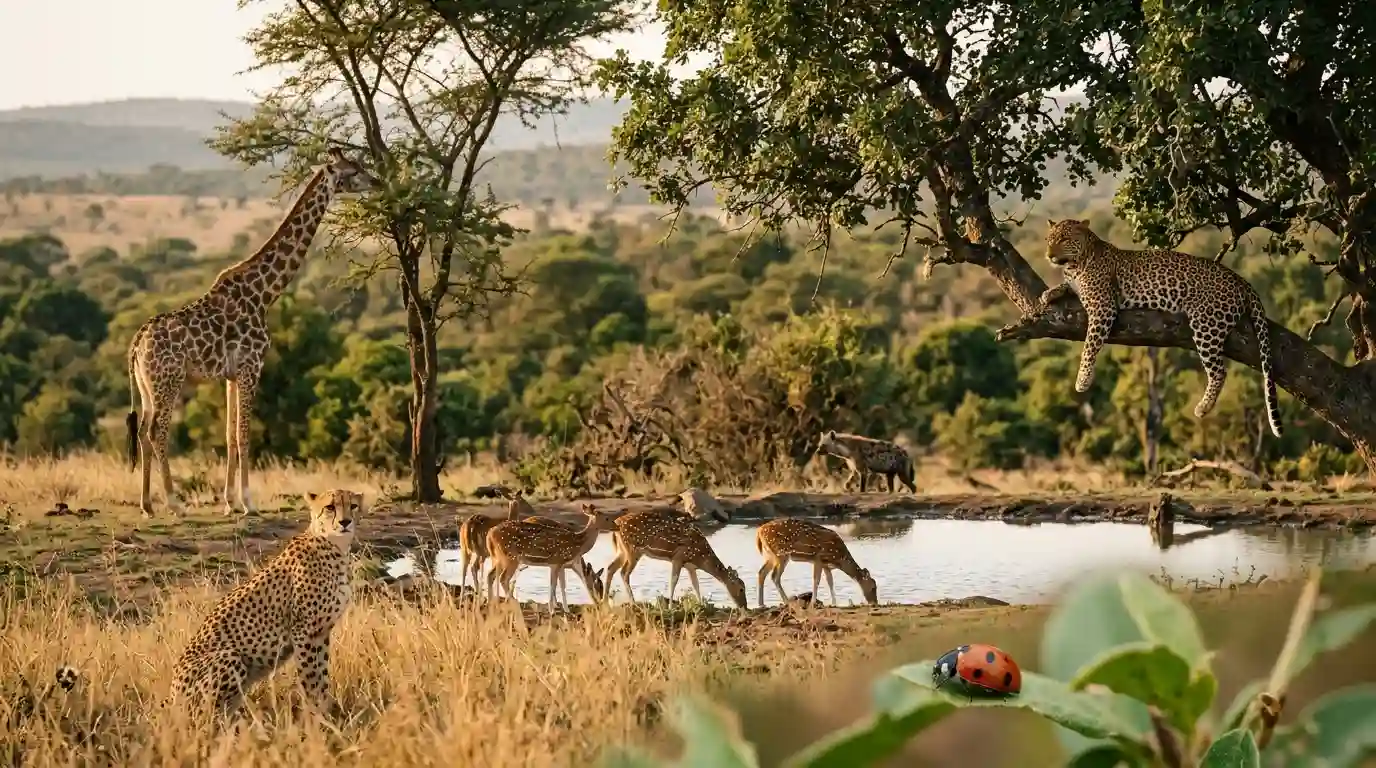
Animals that have spots live in almost every habitat on Earth. You can find them in rainforests, open savannas, snowy mountains, coral reefs and even in our homes. Some use their spots to hide. Others use bright markings to warn enemies, and some use patterns to recognize each other.
This guide gives you a clear spotted animals list with pictures in mind, so you can add a photo beside each animal. It covers 26 animals, with scientific names, diets, lifespans, conservation status and fun facts. It also answers common questions such as “What wild animal has spots?” and “Do cheetahs have 2,000 spots?”
Quick Answers
What Is a Spotted Animal?
A spotted animal is any animal whose body shows round, oval, irregular or ring-shaped marks that contrast with its main color. The marks can be on fur, skin, feathers, scales or a shell. Some patterns last for life. Others appear, fade or grow as the animal ages.
What Wild Animal Has Spots?
Many wild animals have spots. The most famous are the leopard, cheetah, jaguar, giraffe, spotted hyena and African wild dog. In the ocean, the whale shark and spotted eagle ray are well known. The next section lists the best-known ones.
Which Animal Has Dots?
“Dots” usually means small, round spots. Cheetahs have solid black dots on a tan coat. Ladybugs have black dots on red wings. Dalmatians have dark dots on a white coat. Atlantic spotted dolphins gain small dots as they grow older.
Top 10 Spotted Wild Animals
If you want the quick version, these are ten wild animals with spots that most people know:
| Rank | Animal | Type of Spots | Where It Lives |
|---|---|---|---|
| 1 | Leopard | Rosettes | Africa and Asia |
| 2 | Cheetah | Solid black spots | Africa and a small part of Iran |
| 3 | Jaguar | Rosettes with inner dots | Central and South America |
| 4 | Giraffe | Large brown patches | African savannas |
| 5 | Snow leopard | Large rosettes | Mountains of Central and South Asia |
| 6 | Spotted hyena | Dark irregular spots | Sub-Saharan Africa |
| 7 | African wild dog | Mixed patches | African savannas and woodlands |
| 8 | Axis deer (chital) | White spots | South Asia |
| 9 | Whale shark | White spots and stripes | Warm oceans |
| 10 | Ocelot | Spots, chain-like rosettes and stripes | Americas |
You will find more detail on each of these in the full list below.

Why Do Animals Have Spots?
Spots are not just for decoration. They help animals survive in several ways:
- Camouflage: Spots break up the outline of an animal’s body. This is called disruptive coloration. It makes the animal hard to see in dappled sunlight, tall grass or moving water.
- Warning signals: Bright spots tell predators that an animal tastes bad or is poisonous. Scientists call this aposematic, or warning, coloration.
- Countershading: Many ocean animals are dark above and light below. Spots add to this effect and hide the body shape in open water.
- Identification: In many species, every animal has its own pattern. Researchers photograph these patterns to track individuals without tagging them.
- Protection for young animals: Some babies are born with spots that fade as they grow. Others gain more spots with age.
- Temperature control: In giraffes, the dark patches sit over networks of blood vessels that may help release extra body heat.
For a deeper look at the science, see our guide on why animals have spots.

How Do Spots Form?
Spots come from pigment cells in the skin, fur or feathers. Genes control the size, shape and color of the spots while the animal is still developing. Scientists, including the mathematician Alan Turing, have suggested that simple chemical signals in a growing embryo can create spots and stripes. This is why even closely related animals can have very different patterns.
Melanism is one example of a gene change. It gives some leopards and jaguars an all-dark coat, which people call a black panther. The rosettes are still there, but they are hard to see except in bright light. You can read more in our article on what melanism is.
Quick Facts Table
| Animal | Scientific Name | Class | Diet | Lifespan |
|---|---|---|---|---|
| Leopard | Panthera pardus | Mammal | Carnivore | 12–17 years (wild) |
| Cheetah | Acinonyx jubatus | Mammal | Carnivore | 10–12 years (wild) |
| Jaguar | Panthera onca | Mammal | Carnivore | 12–15 years (wild) |
| Snow leopard | Panthera uncia | Mammal | Carnivore | 15–18 years (wild) |
| Ocelot | Leopardus pardalis | Mammal | Carnivore | 10–13 years (wild) |
| Giraffe | Giraffa spp. | Mammal | Herbivore | 20–25 years |
| Spotted hyena | Crocuta crocuta | Mammal | Carnivore | 20+ years |
| African wild dog | Lycaon pictus | Mammal | Carnivore | 10–12 years (wild) |
| Fallow deer | Dama dama | Mammal | Herbivore | 16–20 years |
| Whale shark | Rhincodon typus | Cartilaginous fish | Filter feeder | 70+ years (estimated) |
| Spotted eagle ray | Aetobatus narinari | Cartilaginous fish | Carnivore | Up to 25 years |
| Atlantic spotted dolphin | Stenella frontalis | Mammal | Carnivore | 40–50 years |
| Spotted garden eel | Heteroconger hassi | Bony fish | Carnivore | Up to 35 years |
| Spotted salamander | Ambystoma maculatum | Amphibian | Carnivore | 20 years or more |
| Ladybug | Family Coccinellidae | Insect | Mostly carnivore | 1–2 years |
| Dalmatian | Canis lupus familiaris | Mammal | Omnivore | 11–13 years |
Spotted Animals List With Pictures
Use the photo next to each animal to compare the patterns. Look for solid spots, rings, patches and dots. Conservation status follows the IUCN Red List and can change, so check the latest listing before you publish.
Spotted Big Cats and Wild Cats
1. Leopard
Scientific name: Panthera pardus | Diet: Carnivore | Weight: about 30–90 kg | IUCN status: Vulnerable

The leopard is one of the most famous animals with spots. Its coat is covered in rosettes, which are ring-shaped clusters of marks. These help it hide in trees and thick bush. Leopards live in Africa and parts of Asia. After a kill, they often drag their prey up into branches to keep it safe from lions and hyenas.
Fun fact: A black panther is simply a leopard (or a jaguar) with a dark coat caused by melanism. The rosettes are still visible in bright light.
2. Cheetah
Scientific name: Acinonyx jubatus | Diet: Carnivore | Weight: about 21–72 kg | IUCN status: Vulnerable

The cheetah is the fastest land animal. Unlike the leopard, it has solid black spots instead of rosettes. Most cheetahs live in sub-Saharan Africa, with a very small group left in Iran. Their spots reduce contrast against dry grass, helping them get close to gazelles and impalas before a sprint.
Fun fact: Cheetah cubs have a fluffy gray mantle on their backs, which may help them look like a honey badger to passing predators.
3. Jaguar
Scientific name: Panthera onca | Diet: Carnivore | Weight: about 45–120 kg | IUCN status: Near Threatened

The jaguar is the largest cat in the Americas, found from Mexico to northern Argentina. It looks like a leopard, but it is stockier, and its rosettes usually have small black dots inside them. Jaguars live in rainforests, wetlands and river areas, and they are strong swimmers.
Fun fact: A jaguar’s bite is strong enough to crush turtle shells and caiman skulls.
4. Snow Leopard
Scientific name: Panthera uncia | Diet: Carnivore | Weight: about 22–55 kg | IUCN status: Vulnerable

The snow leopard lives in the high mountains of Central and South Asia, including the Himalayas. Its thick smoky-gray coat has large black rosettes that blend with rocks and snow. It hunts wild sheep, ibex and marmots.
Fun fact: Its long, bushy tail helps it balance on steep cliffs and wraps around its face to keep it warm while it rests.
5. Ocelot
Scientific name: Leopardus pardalis | Diet: Carnivore | Weight: about 8–16 kg | IUCN status: Least Concern

The ocelot is a medium-sized wild cat that ranges from the southern United States to South America. Its coat shows a mix of elongated spots, chain-like rosettes and bold stripes. It hunts mostly at night in forests, mangroves and brushland.
Fun fact: Researchers use camera traps to identify individual ocelots because every cat has its own coat design.
6. Serval
Scientific name: Leptailurus serval | Diet: Carnivore | Weight: about 9–18 kg | IUCN status: Least Concern

The serval is a slim African wild cat with black spots on a golden coat and very large ears. It listens for rodents and birds in tall grass, then leaps high to pounce on them.
Fun fact: Servals can jump several feet into the air to catch birds.
Spotted Animals of the Savanna
7. Giraffe
Scientific name: Giraffa spp. | Diet: Herbivore | Height: males can exceed 5.5 m | IUCN status: Vulnerable

The giraffe is the tallest land animal. Its markings are technically irregular patches separated by lighter lines, but most people call them spots. The patches help young calves hide in tree shade, and they may also help with cooling. Giraffes feed on leaves, flowers and seed pods from acacia trees.
Fun fact: No two giraffes have the same coat pattern, so researchers can identify them from photographs.
8. Spotted Hyena
Scientific name: Crocuta crocuta | Diet: Carnivore | Weight: about 40–86 kg | IUCN status: Least Concern

The spotted hyena has dark spots on a tan to gray coat. Hyenas live across sub-Saharan Africa in clans, which can have more than 70 members and are led by females. They are skilled hunters, not just scavengers. Their strong jaws can crush large bones.
Fun fact: Hyenas are more closely related to cats than to dogs.
9. African Wild Dog
Scientific name: Lycaon pictus | Diet: Carnivore | Weight: about 18–36 kg | IUCN status: Endangered

The African wild dog, also called the painted dog, has a coat of black, brown, white and yellow patches. Packs hunt together with great teamwork. Habitat loss, disease and conflict with people have made this species endangered.
Fun fact: Pack members often share food with sick or older dogs.
Spotted Deer
10. Axis Deer (Chital)
Scientific name: Axis axis | Diet: Herbivore | IUCN status: Least Concern

The axis deer, also known as the chital, lives in South Asia, including India and Sri Lanka. It eats grass and leaves, and it keeps its white spots all year round. This sets it apart from many other deer, whose spots fade with age.
Fun fact: Axis deer often feed alongside langur monkeys, which drop leaves and fruit from the trees above.
11. Fallow Deer
Scientific name: Dama dama | Diet: Herbivore | Weight: about 30–100 kg | IUCN status: Least Concern

The fallow deer is native to parts of Europe and western Asia and now lives in many other countries. Adults usually keep their white spots through summer and lose them in winter, when the coat turns darker and thicker. Males grow broad, flat antlers.
Fun fact: A fallow fawn’s spotted coat helps it blend into tall vegetation.
12. Sika Deer
Scientific name: Cervus nippon | Diet: Herbivore | IUCN status: Least Concern

The sika deer is native to East Asia, including Japan. Its chestnut coat is covered with white spots in summer. In winter, the spots fade as the coat turns darker.
Fun fact: Sika deer are known for their wide range of whistles and calls.
Spotted Animals in the Ocean
13. Whale Shark
Scientific name: Rhincodon typus | Diet: Filter feeder | Length: over 12 m | IUCN status: Endangered

The whale shark is the largest fish in the world. White spots and pale stripes cover its dark gray body. Marine biologists use these patterns like fingerprints to identify and follow individual sharks in photo databases. Despite its huge size, it feeds on plankton, small fish and fish eggs.
Fun fact: Whale sharks face threats from boat strikes, pollution and unsustainable fishing.
14. Spotted Eagle Ray
Scientific name: Aetobatus narinari | Diet: Carnivore | Wingspan: over 3 m | IUCN status: Endangered

The spotted eagle ray has bright white spots on a dark blue or black back. It glides above coral reefs and sandy seabeds and crushes shellfish with strong tooth plates. The spots break up its outline in shifting sunlight.
Fun fact: It can leap completely out of the water.
15. Atlantic Spotted Dolphin
Scientific name: Stenella frontalis | Diet: Carnivore | Length: about 1.6–2.3 m | IUCN status: Least Concern

Atlantic spotted dolphins are born with few or no spots. They gain more spots as they grow, so older dolphins look much more spotted than calves. They live in social groups called pods and use echolocation to find fish and squid.
Fun fact: Adults often have dense spots across most of the body.
16. Spotted Garden Eel
Scientific name: Heteroconger hassi | Diet: Carnivore | Length: about 30–40 cm | IUCN status: Least Concern

The spotted garden eel lives in colonies on sandy seabeds near coral reefs in the Indo-Pacific. Its white body has evenly spaced black spots. It keeps its tail in a sand burrow and sways in the current to catch drifting zooplankton.
Fun fact: When danger approaches, the whole colony drops back into the sand.
17. Blue-Ringed Octopus
Scientific name: Hapalochlaena spp. | Diet: Carnivore | IUCN status: Varies by species

This small octopus is dangerous. When it feels threatened, bright blue rings flash across its body as a warning. Its venom is powerful, so it should never be touched.
Fun fact: The rings are a clear example of warning coloration in the sea.
Spotted Birds
18. Spotted Owl
Scientific name: Strix occidentalis | Diet: Carnivore | IUCN status: Near Threatened

The spotted owl lives in old forests of North America, including the Pacific Northwest. Its dark brown feathers with white spots blend with tree bark and dappled light. It hunts rodents, rabbits and squirrels at night, and it is threatened by the logging of old-growth forests.
Fun fact: Spotted owls often nest in tree cavities or in old woodpecker holes.
19. Spot-Billed Pelican
Scientific name: Pelecanus philippensis | Diet: Carnivore (fish) | IUCN status: Near Threatened

This large water bird lives in South and Southeast Asia. It is named for the dark spots on its bill. It feeds on fish, which it scoops up with its large throat pouch.
Fun fact: Spot-billed pelicans nest in colonies, often in tall trees near water.
Spotted Reptiles and Amphibians
20. Leopard Gecko
Scientific name: Eublepharis macularius | Diet: Insectivore | IUCN status: Least Concern

The leopard gecko has dark spots on a yellow to tan body. It comes from dry regions of South and Central Asia, where its coloring helps it blend into rocks and sand. Today it is a popular pet because it is calm and easy to care for.
Fun fact: It can regrow its tail, and the new tail often has a spotted pattern too.
21. Spotted Salamander
Scientific name: Ambystoma maculatum | Diet: Carnivore | Length: about 15–25 cm | IUCN status: Least Concern

The spotted salamander lives in moist forests in eastern North America. Its black body has two rows of bright yellow spots that warn predators about its toxic skin. Scientists also watch amphibians like this one because their thin skin reacts quickly to pollution.
Fun fact: Its eggs share a partnership with green algae. The algae grow inside the egg capsules and give oxygen to the embryos, while the embryos give off waste that feeds the algae. This is a well-known example of mutualism.
22. Harlequin Toad
Scientific name: Atelopus spp. | Diet: Insectivore | IUCN status: Many species Critically Endangered

Harlequin toads live in Central and South American rainforests. Their bright red, yellow or orange patterns warn predators that they are toxic. Many species are in danger because of habitat loss and the chytrid fungus.
Fun fact: Conservation groups now run breeding programs to save some species.
Spotted Insects
23. Ladybug
Scientific name: Family Coccinellidae | Diet: Mostly carnivore | Size: about 1–10 mm | IUCN status: Varies by species

Ladybugs, also called ladybirds or lady beetles, belong to a family of more than 6,000 species. Their red or orange bodies with black spots warn birds and frogs that they taste bitter. Farmers like them because they eat aphids and other plant pests.
Fun fact: Ladybugs grow through complete metamorphosis, passing through egg, larva, pupa and adult stages.
Spotted Pets and Farm Animals
24. Dalmatian
Scientific name: Canis lupus familiaris | Diet: Omnivore | Weight: about 20–32 kg | IUCN status: Not assessed (domestic breed)

Dalmatians are born with plain white coats. Their black or liver-colored spots appear during the first few weeks of life. Long ago they were used as carriage dogs, running alongside horses. Their spots do not help them hide, but they make the breed instantly recognizable.
Fun fact: Genes control the size and spread of the spots, so every Dalmatian has a unique coat.
25. Appaloosa Horse
Diet: Herbivore | Status: Domestic breed

The appaloosa is a horse breed known for its spotted coat. Some appaloosas have spots all over the body, while others have them only on the hips.
Fun fact: Appaloosa horses are bred for their patterns, so no two coats look exactly alike.
26. Cow
Diet: Herbivore | Status: Domestic animal

Many dairy cows, such as Holsteins, have black and white patches. These patterns are inherited, and each cow has its own design. Cow spots are one of the most familiar animal patterns in the world.
Fun fact: Cow print is now a popular design in fashion and home decor.
Animals With Spots by Color
Some readers search for animals by spot color. Here is a simple guide.
Animals That Have Black Spots
Leopard, cheetah, serval, ocelot, spotted hyena, spotted garden eel and ladybug all have black spots. The spots stand out against golden, tan or red coats.
White Spotted Animals
Axis deer, fallow deer, sika deer, whale shark, spotted eagle ray and spotted owl are all white spotted animals. White spots work like patches of sunlight, which helps deer hide in forests and helps ocean animals hide in open water.
Black and White Spotted Animals
Dalmatians and Holstein cows are the best-known black and white spotted animals. Some spotted garden eels also show this look, with black spots on a pale body. Animals that have black and white spots are easy to spot in photos, which makes them popular in pictures and designs. For more, see our list of black and white animals.
Animals With Bright Warning Spots
The spotted salamander has yellow spots. The harlequin toad shows red, yellow or orange. Ladybugs have black spots on red, and the blue-ringed octopus flashes blue rings. All of these colors send the same message: stay away.
Types of Spots
Not all spots look the same. Animals that have spots on their body show several patterns:
| Pattern | What It Looks Like | Example |
|---|---|---|
| Solid spots | Small, filled marks | Cheetah, serval |
| Rosettes | Ring-shaped marks | Leopard, snow leopard |
| Rosettes with inner dots | Rings with a dot inside | Jaguar |
| Patches | Large blocks with light lines between them | Giraffe |
| Rings | Bright circles used as a warning | Blue-ringed octopus |
| Speckles | Many tiny dots | Adult Atlantic spotted dolphin |
Leopard vs Cheetah vs Jaguar
These three spotted cats are often confused. Here is how to tell them apart:
| Feature | Leopard | Cheetah | Jaguar |
|---|---|---|---|
| Spot type | Rosettes without inner dots | Solid round spots | Rosettes with inner dots |
| Body shape | Medium build, short legs | Slim, long legs | Stocky and heavy |
| Face | No tear marks | Black “tear marks” | Broad face, strong jaw |
| Home | Africa and Asia | Africa and a small part of Iran | Central and South America |
| Hunting style | Ambush, climbs trees | Fast chase | Powerful bite, swims well |
For a full breakdown, read our guide on leopard vs cheetah vs jaguar.
Do Cheetahs Have 2,000 Spots?
Cheetahs are often said to have around 2,000 solid black spots. The exact number varies from one cheetah to another, so treat it as a rough estimate, not a fixed count. What stays true is that a cheetah’s spots are solid and round, not ring-shaped like a leopard’s rosettes.
A cheetah’s face also has dark “tear marks” that run from the eyes to the mouth. These marks may reduce sun glare while the cat hunts in bright daylight.
Animals With Spots or Stripes
Spots and stripes both help animals blend into their habitats, but they work best in different settings. Spots suit places with scattered light and shadow, such as forests and coral reefs. Stripes, like those on a zebra or tiger, may work better in tall grass or serve as signals between animals of the same species. You can compare more examples in our list of animals with stripes.
Animals That Have Spots and Stripes
Some animals have both patterns on one body:
- Ocelot: spots, chain-like rosettes and stripes
- Whale shark: white spots with pale stripes
- Tapir calves: white stripes and spots that fade into a plain coat as they grow
- Spotted hyena (young): darker, stronger markings that can fade slightly with age
We cover more of these in our guide to animals with spots and stripes.

Camouflage vs Warning Spots
Spots can send two very different messages. Some say “you can’t see me.” Others say “don’t eat me.”
| Feature | Camouflage Spots | Warning Spots |
|---|---|---|
| Purpose | Help the animal hide | Warn predators to stay away |
| Colors | Earth tones: brown, tan, gray, black | Bright: red, yellow, orange, blue |
| Examples | Leopard, cheetah, fallow deer | Ladybug, spotted salamander, harlequin toad |
| Who benefits | Hunters and prey animals | Animals with toxins or bad taste |
| Scientific term | Disruptive coloration | Aposematic coloration |
Spotted Animals That Eat Leaves
Some spotted animals are plant-eaters. Animals that eat leaves and have spots on them include:
- Giraffe: eats leaves, flowers and seed pods from acacia trees
- Axis deer (chital): eats grass and leaves
- Fallow deer: eats grass, herbs, leaves, bark and acorns
- Sika deer: eats grass and leaves
Their spotted coats help them hide in light and shadow while they graze and browse.
Easy List of Spotted Animals for Kids
This list works well for kids and for classroom tasks like “circle the animals that have spots.” Here are ten spotted animals that are easy to recognize:
- Leopard
- Cheetah
- Giraffe
- Dalmatian
- Ladybug
- Whale shark
- Spotted deer (chital)
- Cow
- Jaguar
- Leopard gecko
Animals that do not have spots include the lion, elephant and zebra (which has stripes).
How Scientists Use Spots to Study Animals
Because many spotted animals have unique patterns, spots work like fingerprints. Researchers use them to study wildlife without harming it:
- Photo identification: Scientists photograph spot patterns on whale sharks, giraffes, leopards, jaguars and African wild dogs. Software matches new photos to a database, so each animal can be followed over many years.
- Camera traps: Hidden cameras in forests capture ocelots, jaguars and leopards. Each coat pattern helps researchers count how many individual cats live in an area.
- Population tracking: Repeated sightings show how far animals travel, how long they live and whether their numbers are rising or falling.
This method is gentler than tagging, and it helps conservation groups decide where to focus their protection efforts.
Animal Prints and Tracks
Spotted animals have inspired a lot of human design. Leopard print, cheetah print, cow print and Dalmatian spots are popular in fashion, fabric and home decor. See our guide to animal print patterns for more.
Tracks tell a story too. Most cats have retractable claws, so their paw prints usually show only the pads. The cheetah is different because its claws are only semi-retractable, so claw marks often show in its tracks.
How Spotted Animals Adapt to Their Environment
Physical adaptations: Leopards, jaguars, ocelots and snow leopards have coat patterns that break up their outline. Whale sharks and eagle rays combine spots with countershading to stay hidden in open water.
Behavioral adaptations: Leopards stalk slowly through plants. Snow leopards use rocky ground for cover. Ocelots hunt at night. Garden eels hide in burrows and only show their upper bodies to feed. African wild dogs and spotted hyenas hunt in groups.
Evolutionary adaptations: Over millions of years, animals whose markings helped them hide, hunt or stay safe were more likely to survive and have young. This is natural selection. Warning spots on salamanders and ladybugs evolved because predators learn to avoid them.
Body adaptations: Giraffes cool off through blood vessels under their patches. Snow leopards stay warm with dense fur. Cheetahs have large lungs and a flexible spine for fast chases.
Why Spotted Animals Are Important in Nature
Balanced food chains: Leopards, jaguars, ocelots, wild dogs and hyenas keep herbivore and small mammal numbers in check. This protects plants from overgrazing.
Biodiversity: Giraffes shape tree growth through browsing, and fallow deer influence how forests regrow. Whale sharks move nutrients across oceans during their migrations.
Natural pest control: Ladybugs eat aphids and other pests, which reduces the need for chemical pesticides.
Nutrient cycling: Hyenas remove carcasses that could spread disease and return nutrients to the ecosystem.
Indicators of environmental health: Spotted salamanders react quickly to pollution, so falling numbers can warn of problems in wetlands and forests. Whale sharks and dolphins reflect the health of the oceans.
Conservation: Large predators are called umbrella species. Protecting enough habitat for them also protects many smaller plants and animals that share the same space.
Are Spotted Animals Endangered?
Some spotted animals are in danger, while others are common. Snow leopards, African wild dogs, whale sharks, harlequin toads and some jaguar populations face serious threats. The main causes are habitat loss, illegal hunting, pollution, climate change, disease and conflict with people. Ladybugs, fallow deer and cattle are far more widespread, although local populations can still be affected by changes in their environment.
| Animal | IUCN Status | Main Threats |
|---|---|---|
| African wild dog | Endangered | Habitat loss, disease, conflict with people |
| Whale shark | Endangered | Boat strikes, fishing, pollution |
| Spotted eagle ray | Endangered | Fishing and habitat loss |
| Snow leopard | Vulnerable | Poaching, loss of prey, climate change |
| Cheetah | Vulnerable | Habitat fragmentation, fewer prey animals |
| Leopard | Vulnerable | Habitat loss, hunting |
| Harlequin toad | Many species Critically Endangered | Chytrid fungus, deforestation |
Read more in our article on endangered spotted animals.
Common Myths About Animals With Spots
Myth 1: All spotted animals use their spots for camouflage. Not always. Ladybugs, spotted salamanders and harlequin toads use bright spots to warn predators, not to hide.
Myth 2: Every spotted big cat is a leopard. Leopards, jaguars, ocelots, cheetahs and snow leopards all have spots, but the patterns are different.
Myth 3: Spots are identical within a species. Many spotted animals have unique patterns. Researchers identify whale sharks, giraffes, leopards, jaguars and African wild dogs by photographing their markings.
Myth 4: Young animals always lose their spots. Some do, like tapirs. Others keep them, like fallow deer, or gain more with age, like Atlantic spotted dolphins.
Myth 5: Spotted animals live only in forests. They live on savannas, in mountains, wetlands, coral reefs, sandy seabeds and even in gardens and homes.
Comparison Table
| Animal | Habitat | Main Adaptation | Ecological Role | Unique Trait |
|---|---|---|---|---|
| Leopard | Forests, savannas | Rosette camouflage | Apex predator | Stores prey in trees |
| Cheetah | Grasslands | Speed and solid spots | Predator | Fastest land animal |
| Jaguar | Rainforests, wetlands | Powerful bite | Apex predator | Strong swimmer |
| Snow leopard | Mountains | Thick spotted fur | Apex predator | Tail aids balance and warmth |
| Giraffe | Savannas | Tall browsing, patch pattern | Shapes vegetation | Pattern helps cooling |
| Spotted hyena | Savannas | Bone-crushing jaws | Predator and scavenger | Female-led clans |
| Whale shark | Tropical oceans | Filter feeding | Nutrient transfer | Largest fish |
| Spotted salamander | Deciduous forests | Toxic skin, warning spots | Indicator species | Eggs partner with algae |
| Ladybug | Gardens, forests | Warning coloration | Natural pest control | Eats many aphids |
| Atlantic spotted dolphin | Atlantic Ocean | Echolocation | Marine predator | Gains spots with age |
Frequently Asked Questions
Many do, including the leopard, cheetah, jaguar, giraffe, spotted hyena, African wild dog, snow leopard and axis deer.
A spotted animal has round, oval or ring-shaped marks on its body that contrast with its main color.
Cheetahs, ladybugs, Dalmatians and Atlantic spotted dolphins all have dots.
Cheetahs are often said to have around 2,000 spots, but the exact number differs between animals.
The cheetah is the fastest land animal and has solid black spots.
The whale shark is the largest spotted animal and the largest fish in the world.
Spots often help animals blend into places with scattered light and shadow, such as forests, grasslands and coral reefs. Stripes may work better in tall grass or serve other signaling roles.
No. Leopards have rosettes (ring-like clusters), while cheetahs have solid round spots.
Yes. Researchers photograph spot patterns to identify whale sharks, giraffes, leopards, jaguars and African wild dogs without tagging them.
No. Some lose their spots as they grow, such as young tapirs. Others gain spots with age, like the Atlantic spotted dolphin.
Bright spots, like those on ladybugs and harlequin toads, warn predators that the animal is toxic or tastes bad.
No. Giraffes and deer are herbivores, whale sharks filter plankton, and ladybugs mainly eat insects. Big cats and African wild dogs are predators.
Conclusion
Animals that have spots show how creative nature can be. Spots help animals hide, warn enemies, control body heat and even tell one another apart. From the leopard and cheetah to the whale shark and ladybug, every spotted animal has a pattern that serves a purpose. Protecting their habitats protects whole ecosystems. Next time you see a spotted animal, look closely at its marks. They tell a story about how it lives.

Daniel Parker is an animal and wildlife writer who enjoys exploring the fascinating world of animals and birds. He writes about animal behavior, diets, physical features, habitats, and the unique traits that make different species interesting. His goal is to turn animal facts into simple, enjoyable guides that are easy for anyone to understand.
