


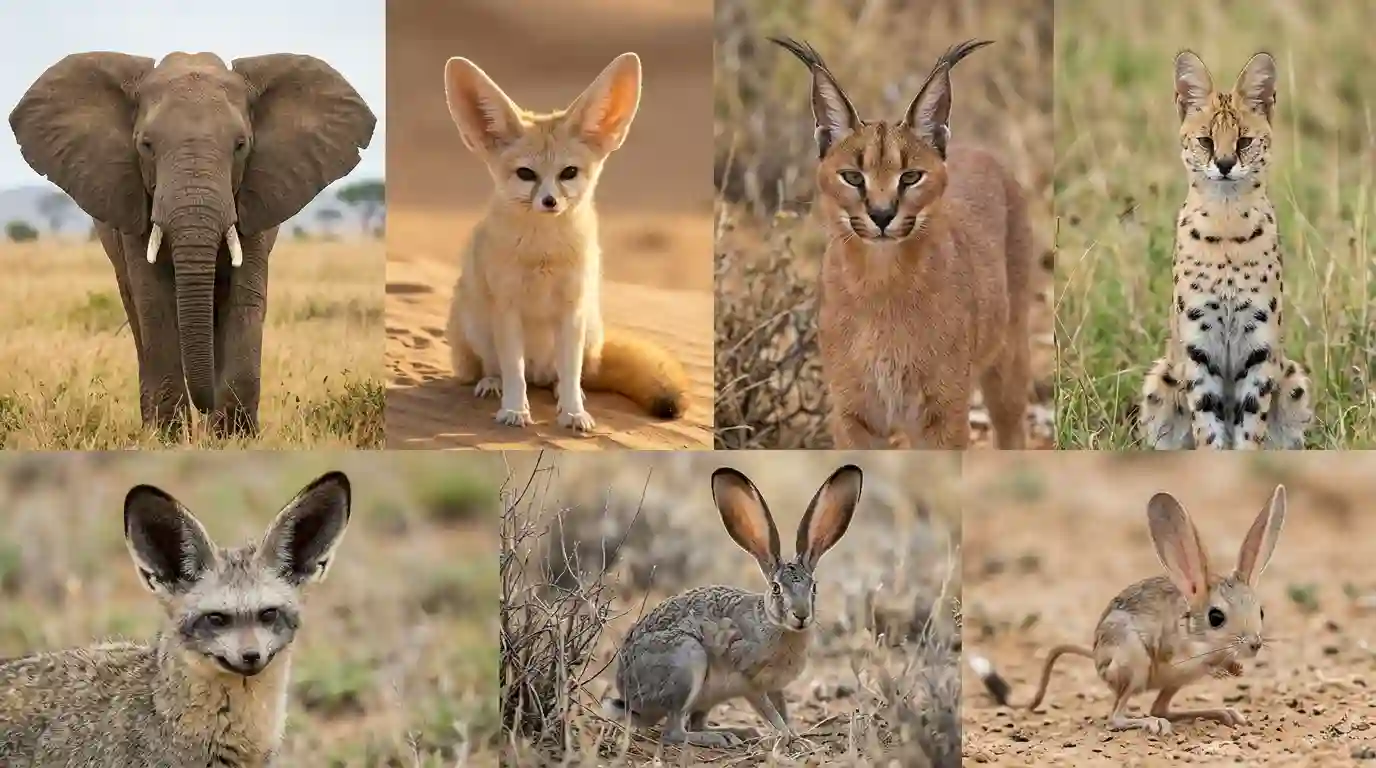

Large ears can look like a quirky design choice, but they usually solve real problems. They catch faint sounds, release body heat, signal mood, and help find prey hidden underground. This guide gives you the names of animals with big ears from around the world and shows how they compare in ear size. It also explains how ears work, why climate shapes them, and what the ears do for each animal. Along the way you’ll find cute, cartoon, desert, Australian and unusual-looking species, kid-friendly facts, and care tips for long-eared pets.
Quick Answer: Top 7 Animals With Big Ears
If you only need the short list, these are the top 7 animals with big ears:
- African elephant: the largest ears in absolute size
- Fennec fox: among the largest ears relative to body size
- Serval: the largest ears for its body size of any cat
- Bat-eared fox: named for its oversized ears
- Black-tailed jackrabbit: long ears built for cooling and spotting predators
- Caracal: tufted ears that rotate independently
- Long-eared jerboa: a tiny desert rodent with ears that look enormous on its body

Animals With Big Ears Family Feud: Likely Answers
If you’re here because of a Family Feud question, these are the answers people most often give, roughly in the order they come to mind:
- Elephant
- Rabbit
- Bat
- Fox (fennec fox or bat-eared fox)
- Donkey
- Mouse
- Dog (such as the basset hound)
Family Feud answers come from surveys, so the exact ranking depends on the episode. Treat this as a likely-answers guide, not an official answer key.
List of Animals With Big Ears (Names)
Here is a quick list of animals with big ears, grouped by type, before the detailed profiles below.
- Mammals, wild: African elephant, Asian elephant, fennec fox, bat-eared fox, serval, caracal, bobcat, coyote, mule deer, gerenuk, oryx, aardvark, African wild dog
- Small mammals: jerboa, kangaroo rat, bush baby (galago), tarsier, aye-aye, jackrabbit, European hare
- Bats: California leaf-nosed bat, brown long-eared bat, pallid bat
- Australian animals: greater bilby, red kangaroo, koala
- Birds: long-eared owl (its “ears” are feather tufts)
- Pets and domestic animals: basset hound, American cocker spaniel, lop rabbit, Flemish giant rabbit, donkey, American Brahman cattle
Why Do Animals Have Big Ears?
Large ears usually serve one or more of four jobs:
- Hearing: A bigger outer ear collects more sound. This helps animals in open habitats, and nocturnal animals that hunt or hide in the dark.
- Cooling: Ears are thin and full of blood vessels close to the skin. Heat escapes from them, which is why many desert and savanna species have large ears.
- Communication: Ear position and movement can show calm, alarm or aggression.
- Hunting: Insect-eaters and small-prey hunters use their ears to pinpoint sounds underground or in dense grass.
Bigger ears don’t automatically mean better hearing, though. Ear shape, the inner ear and the brain all affect how well an animal hears.
How Ears Work: A Quick Look at Ear Anatomy
To see why size matters, it helps to know what the parts of an ear do:
- Outer ear (pinna): The visible part of the ear. It acts like a funnel, collecting sound waves and directing them inward. This is the part that is enlarged in big-eared animals.
- Ear canal: The tube that carries sound to the eardrum.
- Eardrum (tympanic membrane): A thin membrane that vibrates when sound hits it.
- Middle ear bones (ossicles): Tiny bones that pass those vibrations on and amplify them.
- Inner ear (cochlea): A fluid-filled spiral that turns vibrations into nerve signals for the brain.
A larger pinna works like a bigger satellite dish: it gathers more sound and can be turned toward its source. That is why animals such as the mule deer and caracal, which can swivel each ear independently, can locate a sound without moving their heads.
How Big Ears Keep Animals Cool
Ears are among the best heat-release surfaces on a mammal’s body. They are thin, have a large surface area, and carry a dense network of blood vessels just under the skin.
- Widening and narrowing vessels: When an animal is hot, the vessels in its ears widen, so more warm blood flows close to the surface and heat escapes into the air. When it is cold, the vessels narrow to keep heat in. Studies of jackrabbits have shown this kind of blood-flow control in their ears.
- Flapping: An elephant flapping its ears moves air across the surface and carries heat away faster, like a built-in fan.
- Shade and posture: Many desert animals pair big ears with night-time activity or burrowing, so the ears work when it is cooler.
A related trick called countercurrent heat exchange is well documented in the legs and flippers of cold-climate animals. Warm blood heading out to a limb passes some of its heat to the cooler blood coming back, so less heat is lost to the cold. It shows how the same principle of controlling blood flow near the skin can help animals either shed heat or keep it.
Big Ears vs Small Ears: Why Climate Matters
Compare a fennec fox with an Arctic fox. The fennec lives in the Sahara and has huge ears that release heat. The Arctic fox lives in freezing conditions and has short, rounded ears that lose less warmth.
Two well-known rules describe this pattern:
- Allen’s rule: Animals in colder climates tend to have shorter limbs, tails and ears, which reduces heat loss.
- Bergmann’s rule: Within a group of related animals, individuals in colder regions tend to be larger-bodied, which also helps hold heat.
The same ideas help explain why African elephants have much larger ears than Asian elephants. These rules are general trends, and there are plenty of exceptions, but they explain a lot of the pattern you see in the big-eared animals below.
Convergent Evolution: Different Animals, Same Solution
The animals in this guide aren’t closely related. Fennec foxes are canids, jackrabbits are lagomorphs, jerboas are rodents, servals are cats, and bats are in a group of their own. They all ended up with oversized ears because they faced similar problems: heat, open ground, night-time hunting and hidden prey. Biologists call this convergent evolution.
Desert rodents show it clearly. Jerboas of Africa and Asia and kangaroo rats of North America come from different families, yet both evolved big ears, strong hind legs for leaping, and long tails for balance.
Ear Size Comparison: Absolute vs Relative
| Animal | Approx. ear length | Relative to body size |
|---|---|---|
| African elephant | Up to about 6 ft (1.8 m) | Large, but small compared with its huge body |
| Mule deer | About 9–10 in | Moderate |
| Black-tailed jackrabbit | Up to about 7 in | Large |
| Fennec fox | About 6 in | Among the largest of any animal |
| Gerenuk | About 6 in | Moderate to large |
| Bat-eared fox | About 5 in | Very large |
| Greater bilby | Up to about 5 in | Large |
| Serval | Not the longest in absolute terms | Largest of any cat for its body size |
Elephants win on absolute size, while fennec foxes and servals win on proportion. Ear measurements vary by source and individual, so treat these figures as approximate.
Desert Animals With Big Ears
Heat is one of the strongest reasons for oversized ears, so many desert animals with big ears share the same trick: thin ears full of blood vessels that release heat.
Fennec Fox (Vulpes zerda): The smallest fox lives in the Sahara and other dry parts of North Africa. Its ears release heat and let it hear beetles, rodents and other prey moving under the sand. It is mostly nocturnal, so it avoids the worst of the daytime heat.

Black-Tailed Jackrabbit (Lepus californicus): Technically a hare, it lives across the western and central United States and Mexico. Its long, thin ears help it spot coyotes and hawks, and shed heat in arid country.
Long-Eared Jerboa: This small desert rodent has long hind legs for leaping and ears that look huge on its tiny body. The ears help it sense predators such as owls and cool off.
Kangaroo Rat: Living in the deserts of the southwestern United States and Mexico, it uses sensitive hearing to detect owls and snakes at night, then escapes with powerful leaps.
Oryx: The oryx lives in African deserts and dry savannas. Its long, pointed ears help it detect approaching predators across open ground.
Gerenuk (Litocranius walleri): This long-necked antelope of East Africa lives in dry, thorny scrub. Its large, round ears funnel sound toward the inner ear.
Wild Animals With Big Ears Across the Savanna, Forest and Beyond
African Elephant (Loxodonta africana): The elephant has the largest ears of any living animal. Their fan shape and dense network of blood vessels make them natural cooling surfaces, and elephants also use them to communicate. The Asian elephant has noticeably smaller ears.
Serval: This wildcat of the African savanna has very long legs and the largest ears for its body size of any cat. See the spotlight below.
Caracal (Caracal caracal): Also called the desert lynx, it lives in Africa, the Middle East, Central Asia and India. Each ear can rotate independently, and the black tufts at the tips are often described as helping it locate prey.
Bat-Eared Fox (Otocyon megalotis): This fox of eastern and southern Africa listens for termites, dung beetles and beetle larvae below the surface. It often lives as a mated pair or small family group.
African Wild Dog: Its round, fairly large ears help it detect prey and stay coordinated with the pack over long distances.
Aardvark: Africa’s largest insect-eating mammal has long, tubular ears that it can fold down to keep dirt out while digging for ants and termites.
Mule Deer (Odocoileus hemionus): Named for ears that resemble a mule’s, this deer lives in western North America. It can move each ear independently to listen for predators such as coyotes and mountain lions.
Coyote (Canis latrans): Large ears and a long snout give this adaptable canine excellent hearing and smell. It lives in forests, deserts and even cities.
Bobcat: Its tufted ears rotate to follow rabbits and rodents while it stalks through forests and brushland.
European Hare (Lepus europaeus): It has long legs and tall, black-tipped ears, and it can sprint at around 45 mph to escape predators.
Australian Animals With Big Ears
Australia has several well-known big-eared animals:
- Greater bilby (Macrotis lagotis): A nocturnal marsupial with long, pointed ears, strong claws for digging and a long, crested tail. It shelters in burrows from the desert heat. In Australia it is promoted as the “Easter Bilby” in place of the Easter bunny.
- Red kangaroo (Osphranter rufus): The largest kangaroo uses its upright ears to stay alert for danger while grazing in open grassland.
- Koala (Phascolarctos cinereus): Koala ears aren’t elephant-sized, but they are large and rounded compared with the animal’s face. Koalas sleep up to 22 hours a day and feed mostly on eucalyptus leaves.

Small Animals With Big Ears
Some of the most striking big-eared animals are tiny:
- Fennec fox: about the size of a small cat, with ears up to roughly a third of its body length
- Jerboa: a mouse-sized desert rodent with ears that dominate its face
- Bush baby (galago): a small primate whose ears fold and move as it leaps through trees
- Tarsier: a tiny primate with enormous eyes and mobile ears
- Kangaroo rat: a palm-sized desert rodent with a strong sense of hearing
- Brown long-eared bat: ears almost as long as its body
Animals With Big Ears and Eyes
Many night-active animals have both oversized ears and huge eyes, since both help in low light.
Bush Baby (Galago): This small nocturnal primate of sub-Saharan Africa uses mobile ears and sharp night vision to hunt insects in the dark. In Afrikaans it is called a “nagapie,” meaning “night monkey.”
Tarsier: Its enormous eyes and mobile ears help it track insects at night.
Fennec Fox: It fits in this group too, with large eyes and ears suited to a night-time life.
Animals With Big Ears and Fluffy Tails
A few big-eared animals also have bushy or fluffy tails:
- Fennec fox: a thick, black-tipped bushy tail
- Bat-eared fox: a full tail with a dark tip
- Aye-aye: a long, bushy tail along with large, mobile ears. This lemur from Madagascar taps on branches and listens for hollow spots where insect larvae hide.
Animals With Big Ears and Long Tails
Others combine big ears with long tails that help with balance:
- Jerboa: a very long tail with a tuft at the tip, used for balance while leaping
- Kangaroo rat: a long tail that helps it balance during sudden jumps
- Bush baby: a long tail used for balance between branches
- Tarsier: a very long, thin tail
- Greater bilby: a long tail with a crest of fur
Cute Animals With Big Ears
Cuteness is subjective, but a few big-eared species come up in “cute” lists again and again: the fennec fox, bush baby, tarsier, jerboa, serval kitten and any lop rabbit. Big ears, large eyes and small bodies trigger the same “baby-like” response in people, which helps explain why these animals are so popular online.

Ugly Animals With Big Ears?
“Ugly” is in the eye of the beholder, but some big-eared animals are often called unusual-looking:
- Aye-aye: its thin fingers, large eyes and big ears give it an eerie look
- Aardvark: a long snout, tubular ears and an arched back
- Pallid bat and brown long-eared bat: huge, ridged ears that look odd at first glance
Each of these features is useful, whether for finding insects, digging or locating prey by sound.
Cartoon Animals With Big Ears
Big ears are a classic cartoon design choice because they make a character easy to recognize and easy to read emotionally. Famous cartoon animals with big ears include:
- Dumbo: the elephant whose giant ears let him fly
- Bugs Bunny: the long-eared rabbit
- Eeyore: the droopy-eared donkey
These characters exaggerate real traits: elephants really do have huge ears, and rabbits and donkeys really do have long ones.
Stuffed Animals With Big Ears
Big ears are also popular in plush toys. Floppy-eared bunnies, elephants, donkeys and fennec foxes make soft, easy-to-hug toys, since the ears give the toy a recognizable shape and something to hold. Plush versions often exaggerate the ears even more than cartoons do.
Animals With Big Ears for Kids
If you’re sharing this with children, these facts work well:
- Elephants flap their ears to stay cool, like a built-in fan.
- Fennec foxes can hear insects moving under the sand.
- Bats use their ears to “see” in the dark with sound, called echolocation.
- Mule deer can turn each ear separately, like tiny satellite dishes.
- Rabbits and hares use their long ears to spot danger early.
- Caracals have black tufts on their ears that help them hunt at night.
How Do Big-Eared Animals Hear?
Different animals use their ears in different ways:
- Elephants can communicate with very low-frequency sounds, and their ears also help them stay cool.
- Bats use echolocation, sending out sound pulses and listening for the echoes to find food in total darkness.
- Servals and fennec foxes can detect the faint sounds of small prey in tall grass or underground.
- Mule deer and caracals can turn each ear independently to locate a sound without moving their heads.
Hearing Range Comparison
Sound pitch is measured in hertz (Hz). Low numbers are deep rumbles and high numbers are squeaks. Anything below about 20 Hz is called infrasound, and anything above about 20,000 Hz (20 kHz) is ultrasound.
| Animal | Approx. hearing range | What it means |
|---|---|---|
| Humans | About 20 Hz to 20 kHz | The baseline for comparison |
| African elephant | About 17 Hz to roughly 10 kHz | Can hear infrasound, which helps with long-distance communication |
| Many bats | Into the ultrasound range, often 100 kHz or higher in some species | Allows echolocation to catch tiny insects in the dark |
| Kangaroo rat | Especially sensitive to low-frequency sounds | Helps detect the soft wingbeats of owls and the strikes of snakes |
These ranges are approximate and differ between species and individuals. The key point is that big ears are just one part of hearing. Each animal’s range is matched to the sounds that matter most to its survival.
Spotlight: The Serval and Its Remarkable Ears
The serval has the longest legs and, relative to body size, the largest ears of any cat. Its ears can pick up the high-pitched sounds of rodents moving through tall grass, even when the prey is hidden under rocks or in burrows. A serval often stands still, turns its ears toward a sound, then leaps high to pounce. Legs and ears work together as one hunting system.
Animals With Big Ears: Pictures and Galleries
If you’re looking for pictures of animals with big ears, the fennec fox, serval, jerboa, bush baby and tarsier are among the most photogenic. Zoos, wildlife photo agencies and conservation organizations publish good galleries. If you publish your own, give each image a descriptive alt text, such as “fennec fox with large ears in the Sahara.”
Bats and Birds With Big Ears
California Leaf-Nosed Bat (Macrotus californicus): Its nose leaf helps direct sound, and its large ears help regulate body temperature because the blood vessels sit close to the surface.
Pallid Bat: This large-eared desert bat is known for listening to the faint sounds of prey moving on the ground.
Brown Long-Eared Bat: Its huge ears are nearly as long as its body, which helps it catch the faint sounds of insects moving on leaves.
Long-Eared Owl: The “ears” on top of its head are feather tufts, thought to help with camouflage and signaling. Its real ears sit on the sides of the head and are very sensitive in low light.
Why Some Owls Have Asymmetrical Ears
Some owls, such as the barn owl, have ear openings placed at slightly different heights on the skull. Because a sound reaches one ear a split second before the other, and at a slightly different volume, the owl can work out both the direction and the height of a sound. That lets it strike prey it can’t even see.
Ears That Aren’t on the Head
Not every ear sits beside the brain:
- Crickets and katydids: They have ear-like hearing organs on their front legs.
- Grasshoppers: Their hearing organs are on the sides of the abdomen.
- The Dumbo octopus: The “ears” on its head are actually fins used for swimming, not for hearing.
These examples show that “ear” describes a job, hearing, rather than a single body part.
Animals Without Visible Ears
At the other end of the spectrum, some animals have no external ear flaps at all, which makes a useful contrast to the big-eared species above:
- True seals (earless seals): They hear well but have only small openings on the sides of the head, which helps with streamlining. Sea lions, by contrast, have small external ear flaps.
- Snakes: They have no external ears and are thought to pick up ground vibrations mainly through the jaw.
- Dolphins: They have only tiny ear openings and rely heavily on their jaws and echolocation to hear.
- Birds: They hear well but have no external ear flaps, only openings covered by feathers.
Big Ears in Folklore and Culture
Big ears show up often in stories and symbols:
- Aye-aye: In parts of Madagascar, this lemur has traditionally been feared as a bad omen, one reason it has faced persecution.
- Easter Bilby: In Australia, the greater bilby is promoted as an alternative to the Easter bunny to raise awareness for its conservation.
- Moon rabbit: In East Asian folklore, people see a rabbit on the moon.
- Ganesha: The elephant-headed Hindu deity is often shown with large ears, which are commonly interpreted as a symbol of listening carefully.
- Dumbo: Disney’s flying elephant turned huge ears from a flaw into a strength.
Long-Eared Animals: Pets and Domestic Breeds
Not every long-eared animal is wild:
- Basset hound: Its very long ears are often said to help sweep scent toward the nose.
- American cocker spaniel: Known for long, soft, feathered ears.
- Lop rabbits and Flemish giant rabbits: Breeds with long ears, drooping in lops and upright in the giants.
- American Brahman cattle: Large ears increase surface area for cooling in hot weather.
- Donkey: Long ears help with hearing over distance and with releasing heat.
Caring for Long-Eared Pets
Long or floppy ears can trap moisture and reduce airflow, which makes ear problems more likely:
- Dogs: Basset hounds and cocker spaniels are prone to ear infections. Check ears regularly for redness, odor or discharge, and keep them dry after baths and swims.
- Lop rabbits: Their ear canals can narrow, which makes wax buildup and infections more likely. Watch for head shaking, scratching or a tilted head.
- Ear mites: They can affect dogs, cats and rabbits and cause itching and dark debris in the ear.
- Cleaning: Use only a vet-approved ear cleaner, and don’t push cotton swabs deep into the canal.
If you notice signs of infection or discomfort, see a vet. This section is general information, not veterinary advice.
Conservation Snapshot
Big-eared animals face very different levels of risk. Some examples based on IUCN Red List categories:
| Animal | Status (approx.) |
|---|---|
| African elephant | Endangered (bush) / Critically Endangered (forest) |
| Asian elephant | Endangered |
| Fennec fox | Least Concern |
| Serval | Least Concern |
| Caracal | Least Concern |
| Greater bilby | Vulnerable |
| Aye-aye | Endangered |
| African wild dog | Endangered |
Statuses are reviewed periodically, so check the IUCN Red List for the latest assessment before relying on any entry.
FAQs
Common examples include the African elephant, fennec fox, serval, bat-eared fox, black-tailed jackrabbit, caracal and jerboa.
The African elephant has the largest ears in absolute size. Relative to body size, the fennec fox and serval are standouts.
Large ears release excess heat and help detect prey and predators across open ground.
Larger ears usually collect more sound, but ear structure, the inner ear and the brain also matter.
The serval has the largest ears for its body size of any cat. The caracal is also known for its tufted ears.
Final Thoughts
An ear shaped to cool an elephant, hide an owl, find a termite or track a rodent tells you a lot about the habitat that shaped the animal. From the Sahara to Australia, big ears are a clear example of evolution fitting a body to its environment, and of how unrelated species can arrive at the same solution.

Daniel Parker is an animal and wildlife writer who enjoys exploring the fascinating world of animals and birds. He writes about animal behavior, diets, physical features, habitats, and the unique traits that make different species interesting. His goal is to turn animal facts into simple, enjoyable guides that are easy for anyone to understand.
